JUICE Mission, 15 May 2023 - 25 September 2026
On 14 April 2023, the JUpiter ICy moons Explorer (JUICE) mission was launched by an Ariane 5 rocket from French Guiana. It is currently en route towards Jupiter and on arrival will make observations of three of the planet’s four Galilean moons, Ganymede, Europa and Callisto, during 2031-35. Its trajectory towards Jupiter uses fly-by gravitational assists by Earth; the first was in August 2024 and the second in September 2026.
My prospects of imaging JUICE within a few days or weeks of launch did not at first seem promising. It was cloudy over the UK on the evening of launch and then I was away from home for a while. By the time I returned, JUICE was at a considerable distance from Earth. In addition, true darkness lasted less than two hours a night, making it difficult to image a very faint object. I therefore planned to wait for JUICE to return to the neighbourhood of Earth, during the Earth/Moon flyby in August 2024, before attempting to image it.
However, On 09 May, Milan Antoš of the Czech Republic posted an image of JUICE taken using a 250 mm telescope. The following day, Nick James of Chelmford posted on the BAA forum that JUICE was much brighter than expected, at around magnitude 18. So perhaps the craft could be imaged after all…
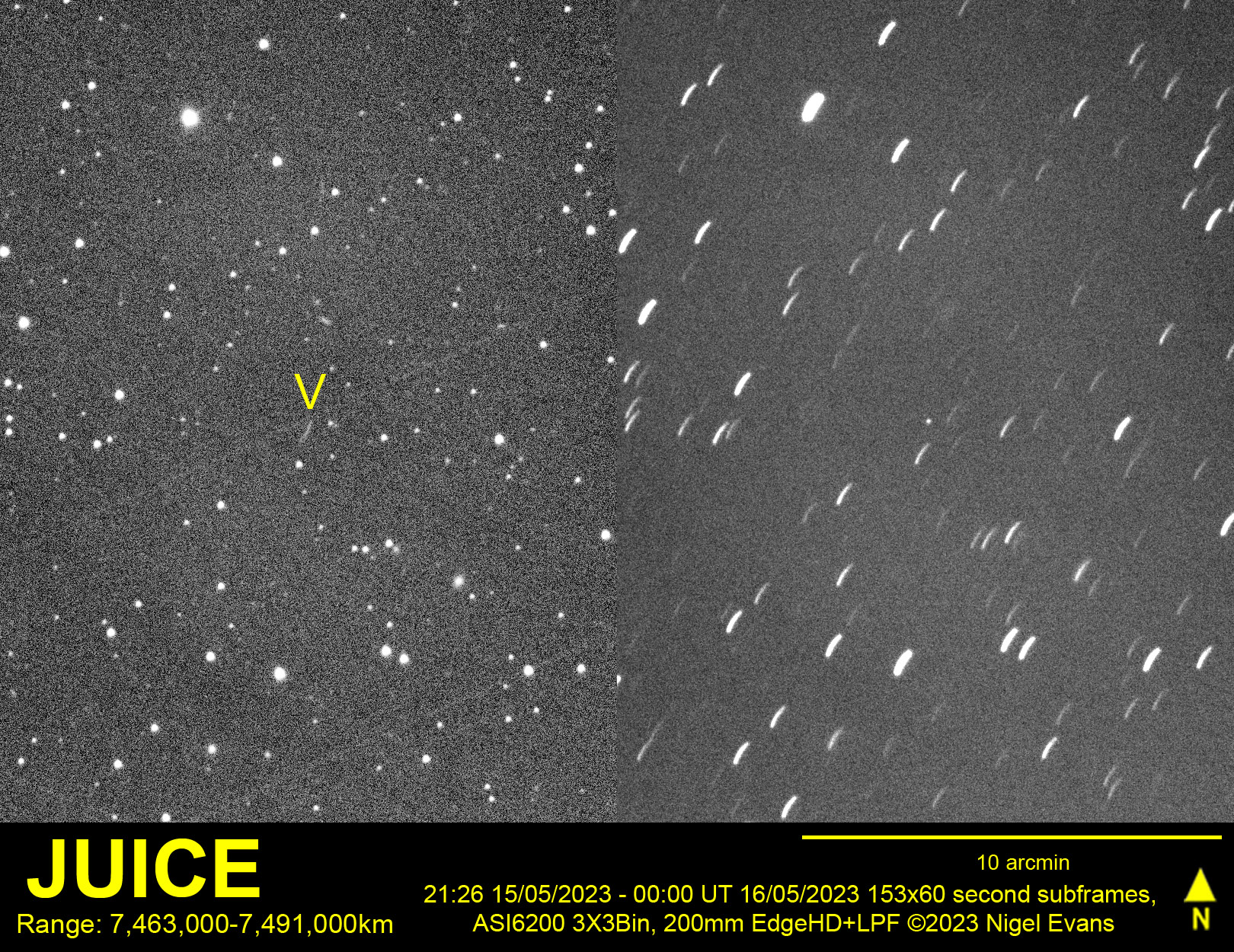
On 15 May, the spacecraft was at a distance of 7.5 million km. It crossed the meridian in the evening nautical twilight at a declination of -4° moving at a rate of only 0.2 arcseconds per minute. I did not know if it was still at magnitude 18 but, in any case, I pressed ahead with imaging. I followed the spacecraft for 2½ hours until it started to get cloudy.
JUICE is not visible in individual 60 s exposures but can be seen in a stack of 20 minutes' worth of images. A video produced from the images shows a faint, slow-moving object very close to the location predicted by JPL Horizons. I was surprised and delighted that I was able to record a man-made object at such a vast distance. No doubt the large solar array of the craft, 85 m2 in area, helps in this regard!
August 2024 soon came around and, mid-month, the JUICE probe approached the Earth and Moon to effect a gravity assist manoeuvre. On 19 August, it passed 700 km from the Moon then, on the evening of the next day, within 7000 km of the Earth (at 01:57 UTC on 21 August), passing over SE Asia and the Pacific Ocean.
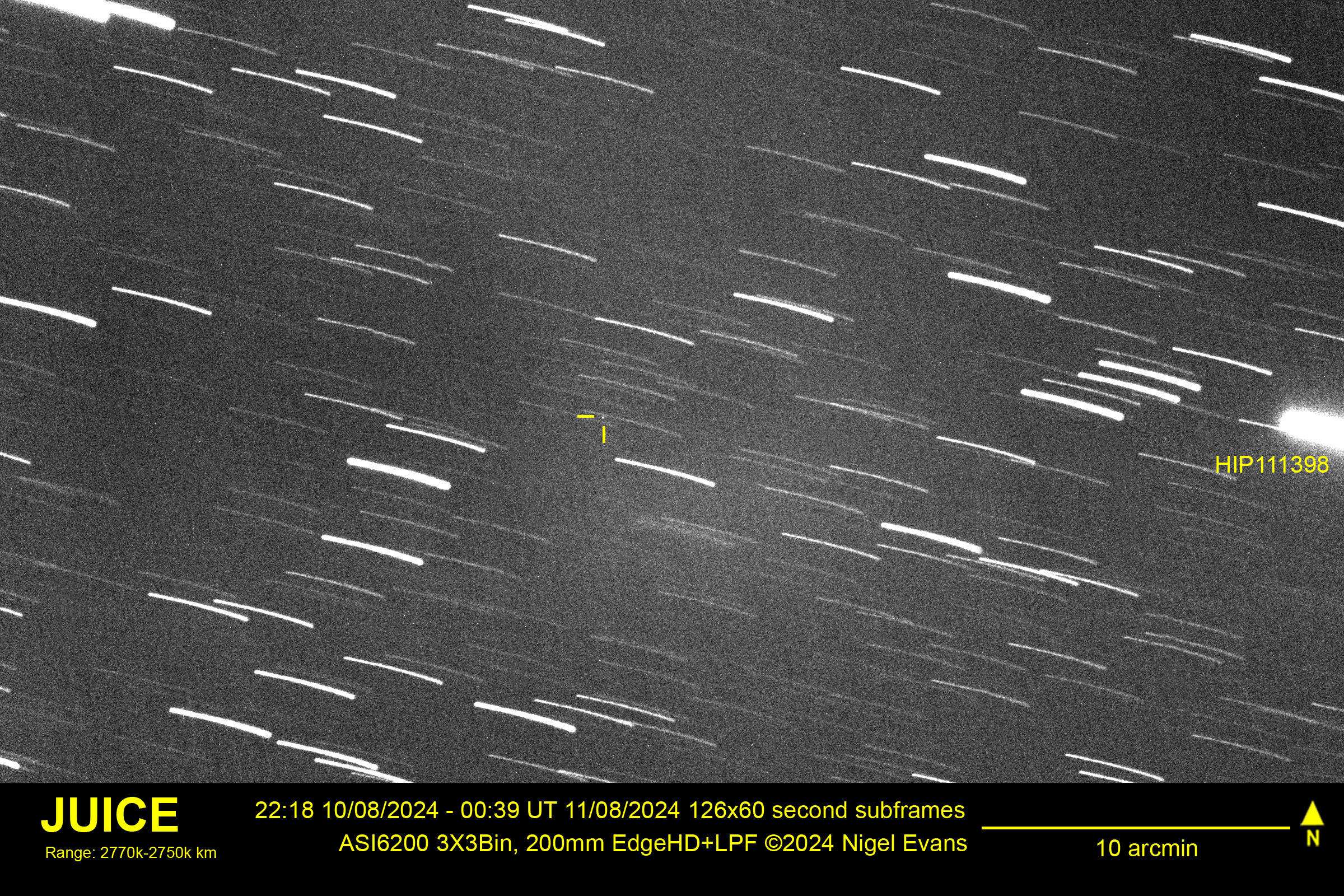
Around mid-month, the craft was near RA 22h 30m, dec -10°, transiting around 01:00 UT, and hence visible from the UK. I first attempted to image the returning probe on 10 August. I followed the predicted position of the probe from an altitude of 18° until 28°. However, the craft was not visible in any single image and I was not sure that I'd recorded it in the trailed and stacked image (because of its low altitude).
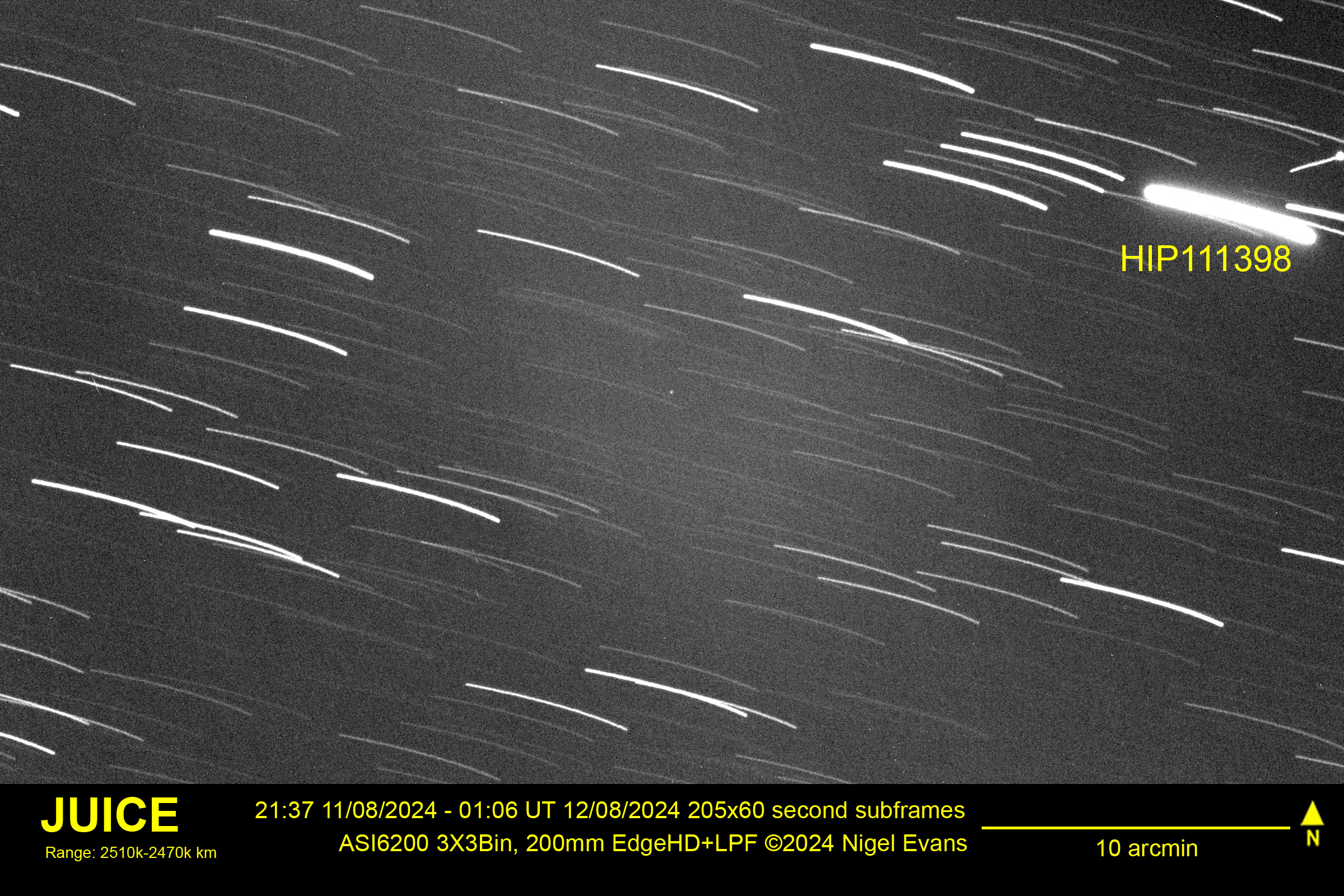
Undeterred, on 11 August, I tried again, following the predicted path from an altitude of 14° until close to transit at 28°. This time, the craft was clearly visible in the trailed and stacked images, and they confirmed that it had been visible too in the previous night's images.
The following still image, taken on 10 August, is a stack, showing the probe at a distance of some 2.8 million km. The video immediately underneath is centred by stacking frames on the probe, so field stars appear as "space-worms".
The following still image and video (captured in the same way as the above) were taken a day later, with the probe slightly closer, at a distance of 2.5 million km.
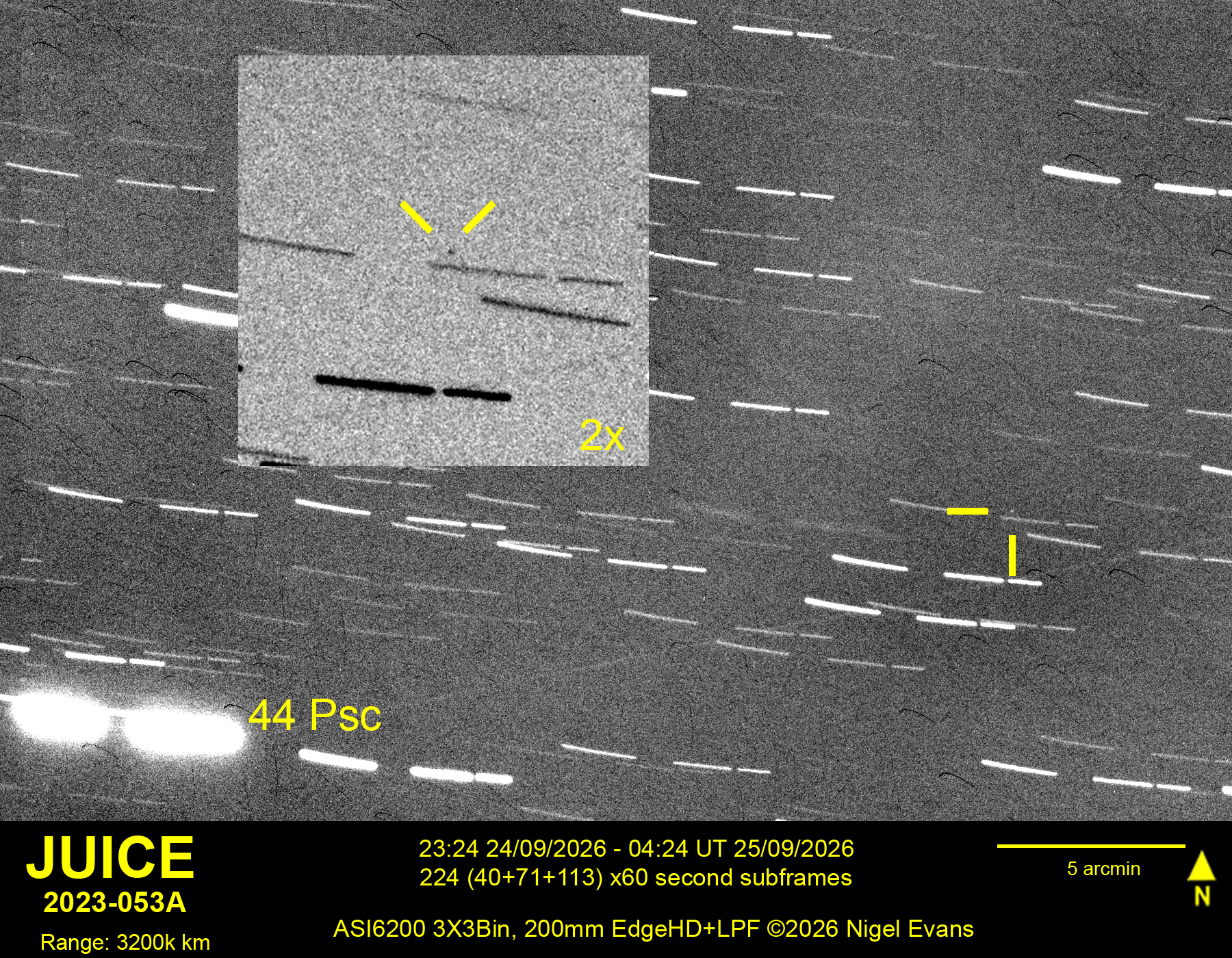
In September 2026, with JUICE approaching the Earth and Moon at the start of its second gravity assist manoeuvre, I suffered two failed attempts at imaging the craft. There was no estimate of its brightness, which made it tricky to know the optimum time to try imaging: trying later, the craft would be closer and appear brighter, but its angular velocity would increase, making it harder to follow.
A third opportunity beckoned on the night of 24/25 September. A 14 day-old Moon sat some 25° distant, illuminating the sky and the cirrus clouds. Fortunately, the clouds moved on! By aligning images on the predicted position of JUICE, the stars left trails, broken in two places by a meridian flip (of the telescope) and then the arrival of uninvited cloud. The probe was extremely faint, fainter than magnitude 19, beyond my ability to measure. See the following image.
The location of JUICE can be found from the NASA JPL Horizons ephemeris (select target body as JUICE).
Nigel Evans.