Falcon 9 Rocket en route to Collision With the Moon, 04 August 2026
In early August 2026, news bulletins predicted that a discarded Falcon 9 upper stage (2025-010D) would collide with the Moon in the early hours of 05 August.
On the morning of 04 August, the rocket was still some 10° distant from the Moon. Although the sky was hazy and the Moon indistinct, I persevered! I recorded more than 700 exposures as the rocket crossed my 40 arcmin FoV. Due to the rapid apparent motion of the rocket, I limited exposures to 5 seconds duration and, as a result, in the vast majority of frames, the rocket is invisible.
The following image is a sequence of stacked images that follow the rocket. They show no evidence of it tumbling.
However, by stepping through the frames one at a time (very tedious!), periodic flashes were visible, lasting just one or two frames, every 32 or 33 frames. The flashes, which were magnitude 14 or 15, have a period of about 208 seconds. By folding the frames, an animation of the flash becomes visible!
The following is a looping gif illustrating the flashing.
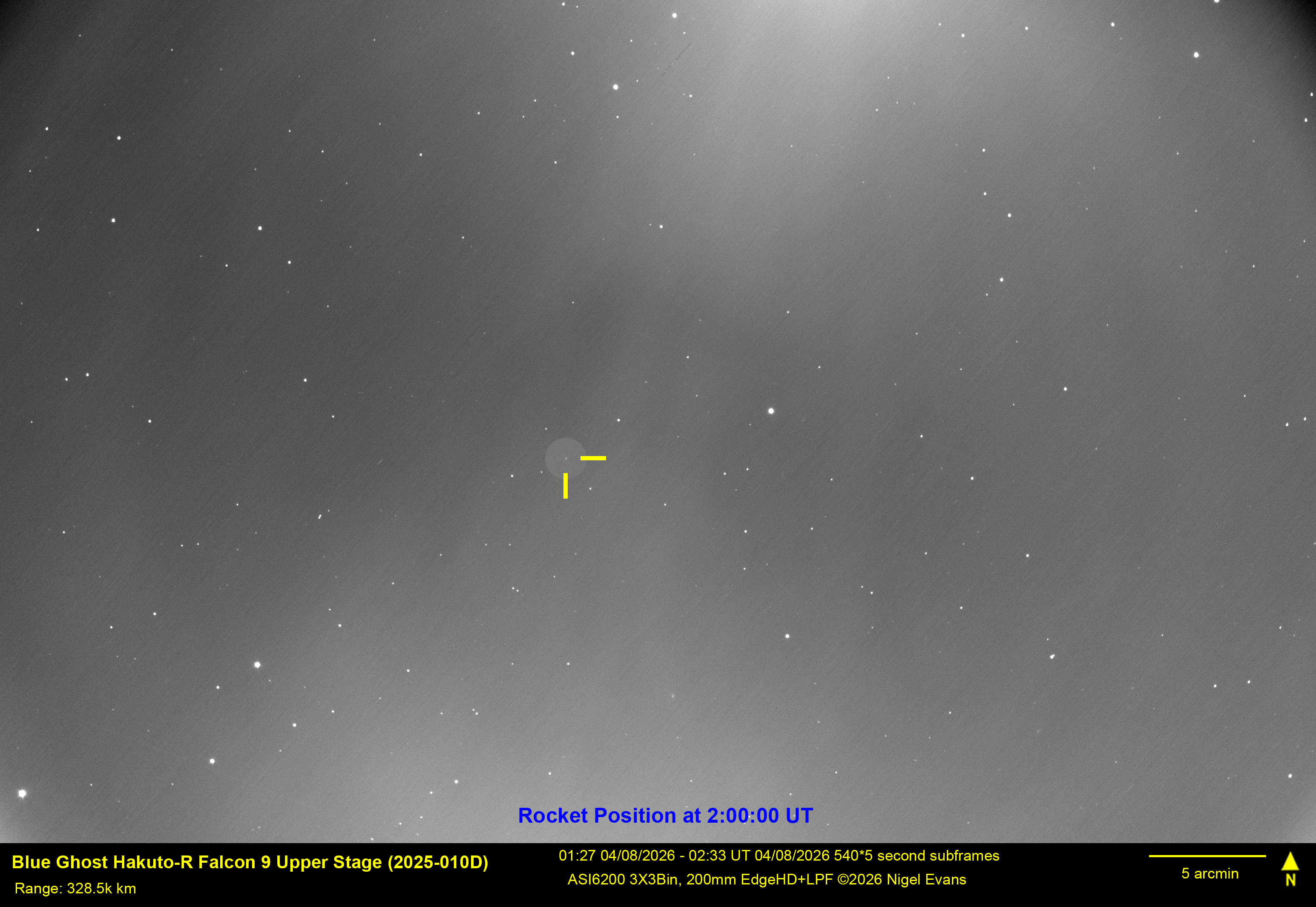
The image of an object with rapid apparent motion (such as a comet) can be presented in two ways: (a) aligned on the stars, and (b) aligned on the object itself. The two approaches can be combined to generate the illusion that the object's motion was frozen by taking a single "short" exposure with a large telescope. The technique can be applied to moving spacecraft and abandoned rocket stages, as demonstrated in the below image, created as if a large telescope recorded the rocket at 02:00 UT on 04 August.
Nigel Evans.