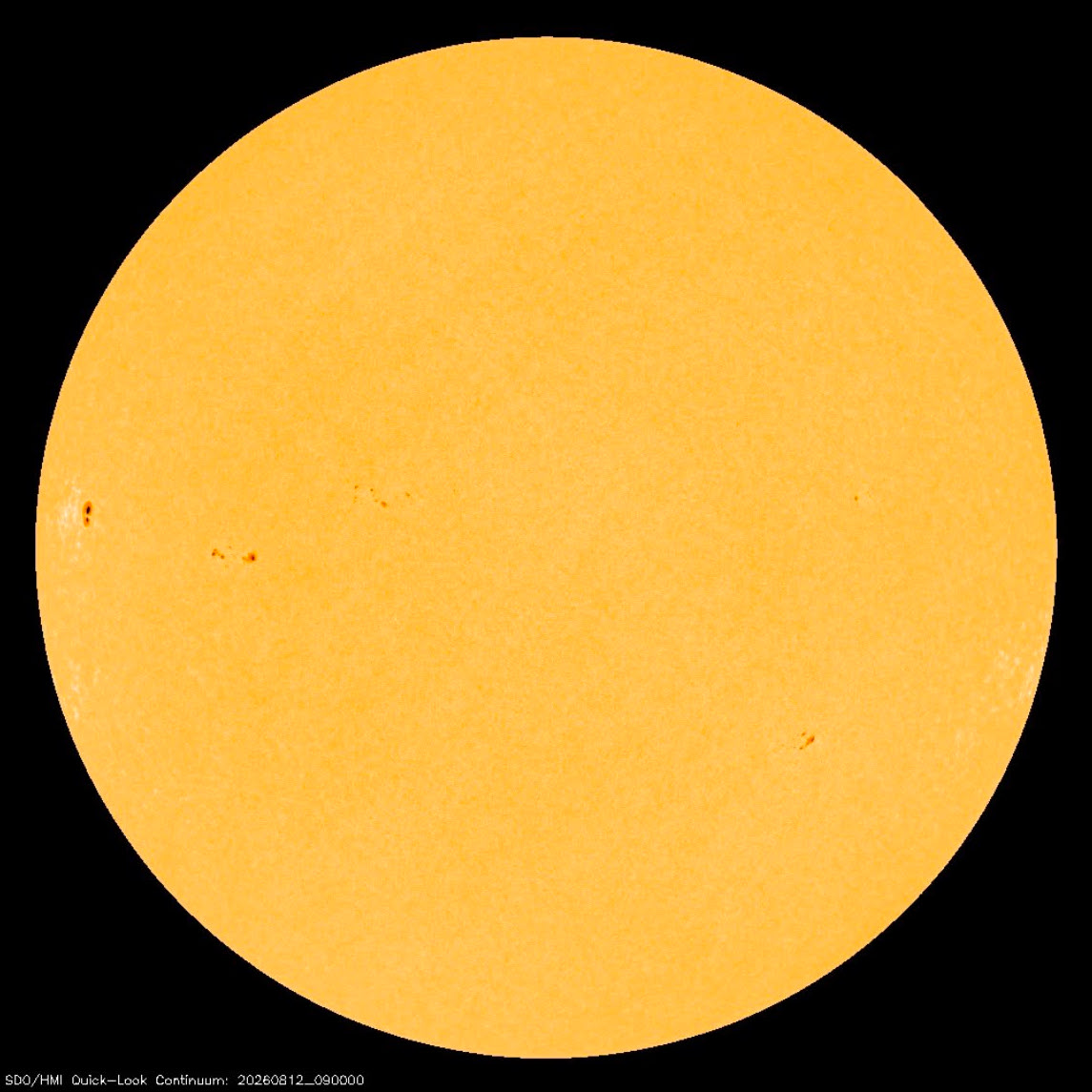
 SOHO continuum image
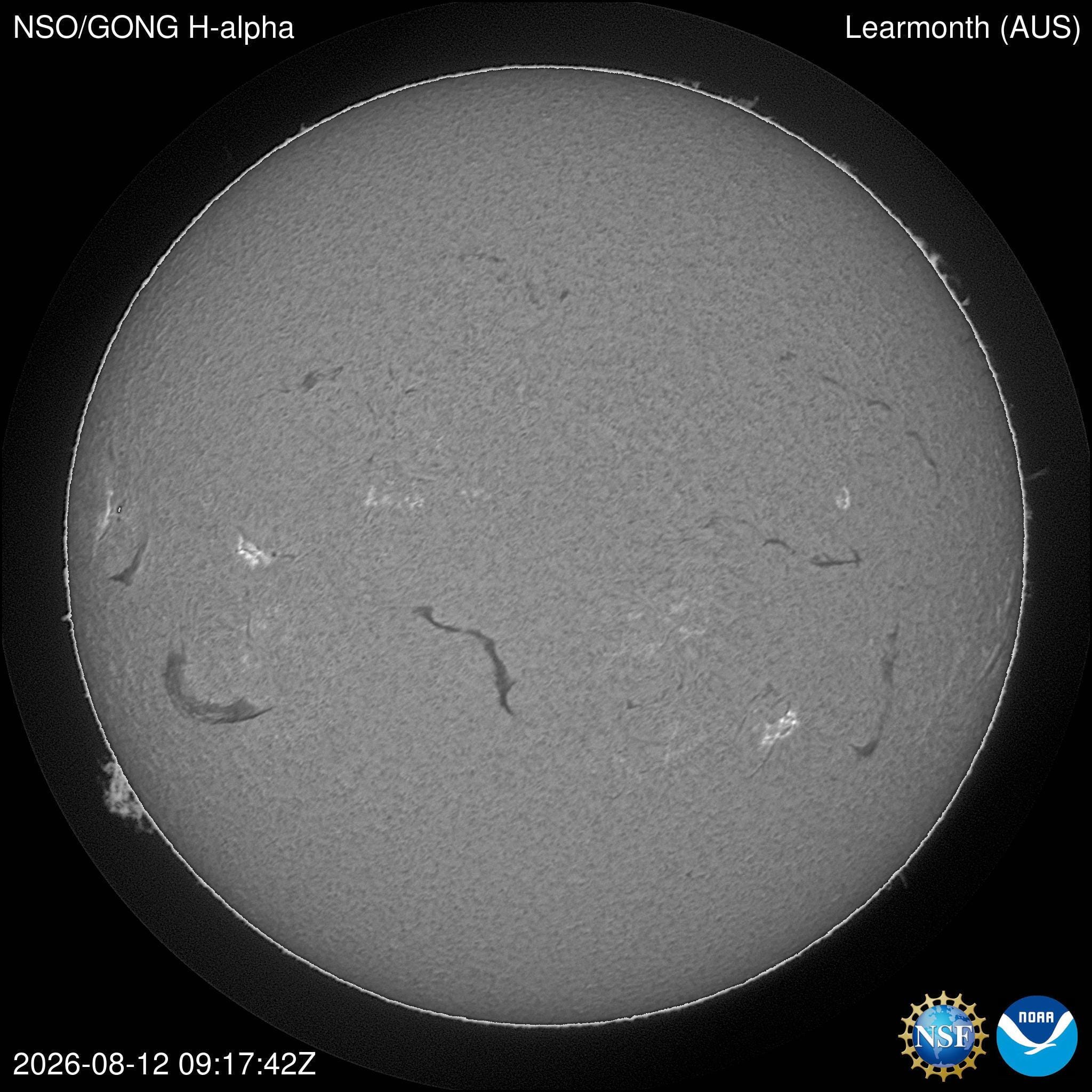 GONG image
Orwell Astronomical Society (Ipswich)
Solar Eclipse,
12 August 2026
A solar eclipse took place on 12 August 2026. Details were as follows (UT):
From the UK, the event was visible as a partial eclipse, with the greatest obscuration of the Sun approximately 90%, the deepest covering until the next total eclipse over the country in 2090. Members of OASI observed the event from the UK and Spain (where it was visible as a total eclipse).
On the morning of the eclipse, images from the SOHO (Solar and Heliospheric Observatory) spacecraft and NASA GONG (Global Oscillation Network Group) showed the solar disk exhibiting several large filaments, a large limb prominence, faculae, plages and a handful of relatively small sunspets. The features are visible in some of the images taken by OASI observers.
SOHO continuum image
GONG image
Observing reports and a selection of photographs from the event are below.
Most OASI observers watched the event from Sutton Heath, near Woodbridge, Suffolk. Martin Cook brought a plentiful supply of certified eclipse glasses for use by casual observers, and more experienced eclipse watchers brought a variety of portable telescopes. A photo of the observing site by Martin is below.

Report by Martin Cook
Two months before the eclipse, Go Stargazing contacted OASI with an offer on bulk buying eclipse glasses. £12 for 50 pairs including postage was an offer too good to miss, so Martin ordered a batch anticipating that, on the day of the eclipse, they would be as hot as FA Cup Final tickets.
The glasses were supplied to members, free of charge, on Monday and Wednesday evenings prior to the eclipse. During the days immediately before the eclipse, OASI was bombarded with emails from members of the public desperate for a pair of glasses; unfortunately we had to disappoint everyone gently with an apology, as the remainder of the stock was reserved for members.
For a few days prior to the eclipse, the media gave the event much publicity. An observing event open to the public ran the risk of large numbers attending, and the possibility of being unable even to park at the observing location! Organisers of the OASI observing event therefore decided that the best plan was to run it as an event open to members and friends.
Andy Gibbs and Martin selected Sutton Heath picnic site as a potential observing location: it offered a large area of relatively flat ground and a good view of the western horizon, important as the end of the eclipse would occur shortly before sunset. They drove to the site a week before the eclipse and identified the best part of the site from which to observe the whole event without the risk of trees obscuring the view.
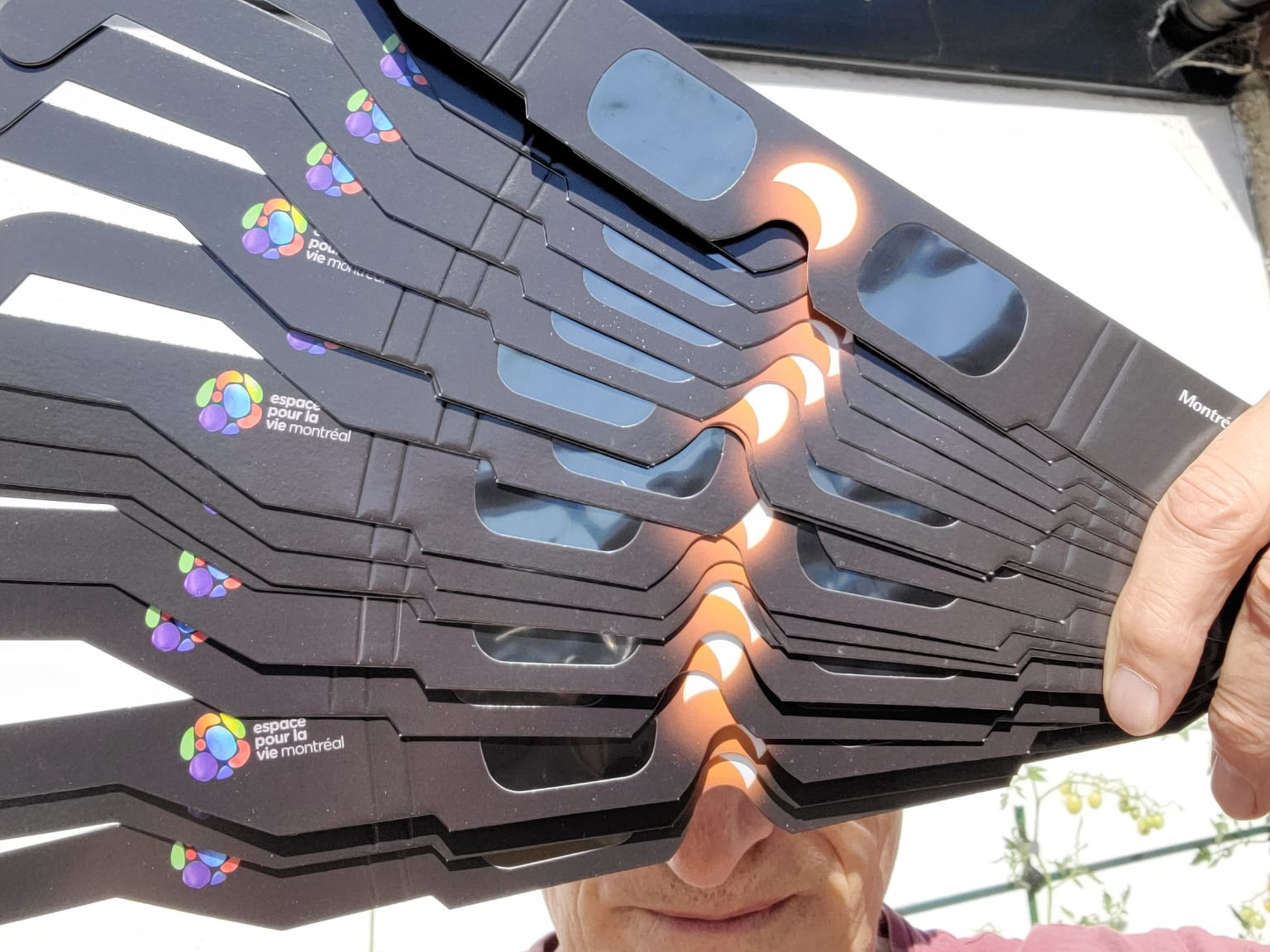
On the day of the eclipse, Martin posted to the OASI WhatsApp group a photo of himself holding up the remaining 20 pairs of eclipse glasses, asking if any observers were without a pair; they were soon snapped up!
The plan was to meet at Sutton Heath from 17:30 but, concerned about the possibility, after the media frenzy on the day, that the car park could quickly become full, Martin arrived at 17:00, and was soon followed by Steve McElvanney, Neil Morley, Roy Gooding and Matt Leeks. With safety in numbers, it was possible to start setting up equipment, making sure that sight lines would not be compromised for the expected two hour duration of observation, either by other observers or by people walking between the Sun and the equipment.
By 17:16, cameras and laptops had started taking time-lapse photos and observers, adorned by solar glasses, eagerly awaited first contact. Matt, observing with his Lunt 60 mm Hα telescope, was first to call "first contact", immediately gaining everyone's attention.
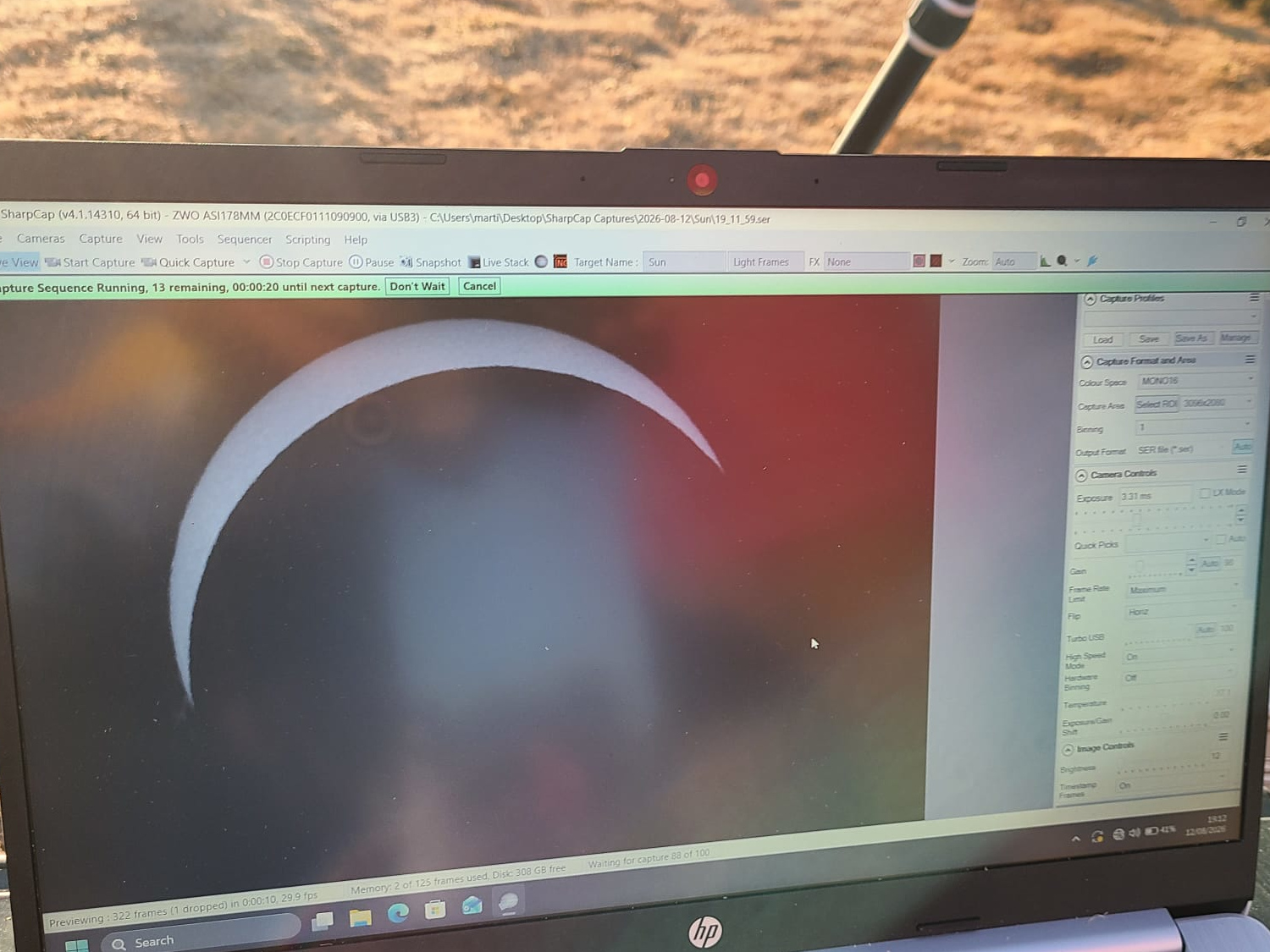
As the Moon slowly ate away at the Sun over the next hour, observers had plenty of time to wander around, chat and look through the range of telescopes in use. Roy's white light setup and Matt’s Lunt proved popular. Andy was able to display on his phone the image produced by the society's Seestar 50, while Martin's setup, a laptop displaying the view through a Lunt LS60TH 60 mm Hα telescope and ZWO 178MM (mono) camera, offered the ability for a group to view and discuss the image easily, in a relaxed manner, while standing up. Unfortunately, Neil, in his haste to arrive, had brought a telescope but forgotten to pack the hand controller; this provided him with the opportunity to circulate and talk to all present. But on his return home, on unpacking the vehicle, the hand controller had been there all alomg, just out of site… Doh!
Maximum eclipse was at 19:12:05 BST. A countdown from Martin leading up to maximum eclipse was followed by a large cheer from the OASI observers; it occasioned strange looks from members of the public on site!
The Moon slipped off the solar disk just as the Sun began to set, becoming obscured by trees on the horizon. It only remained to pack away the equipment, say farewell, and head home to do some image processing.
Thumbnails below show Martin with the remaining eclipse glasses on the morning of the eclipse and imaging in process around the time of greatest eclipse.
The following video shows the first three minutes of the eclipse, speeded up by x6.
The following video follows on from the above. It is a timelapse formed from 20 frames captured every 30 seconds. The Sun filled the entire height of the camera sensor, making it impossible to use PIPP to stabilise the image during post-processing, with the result that the image is jumpy in places.
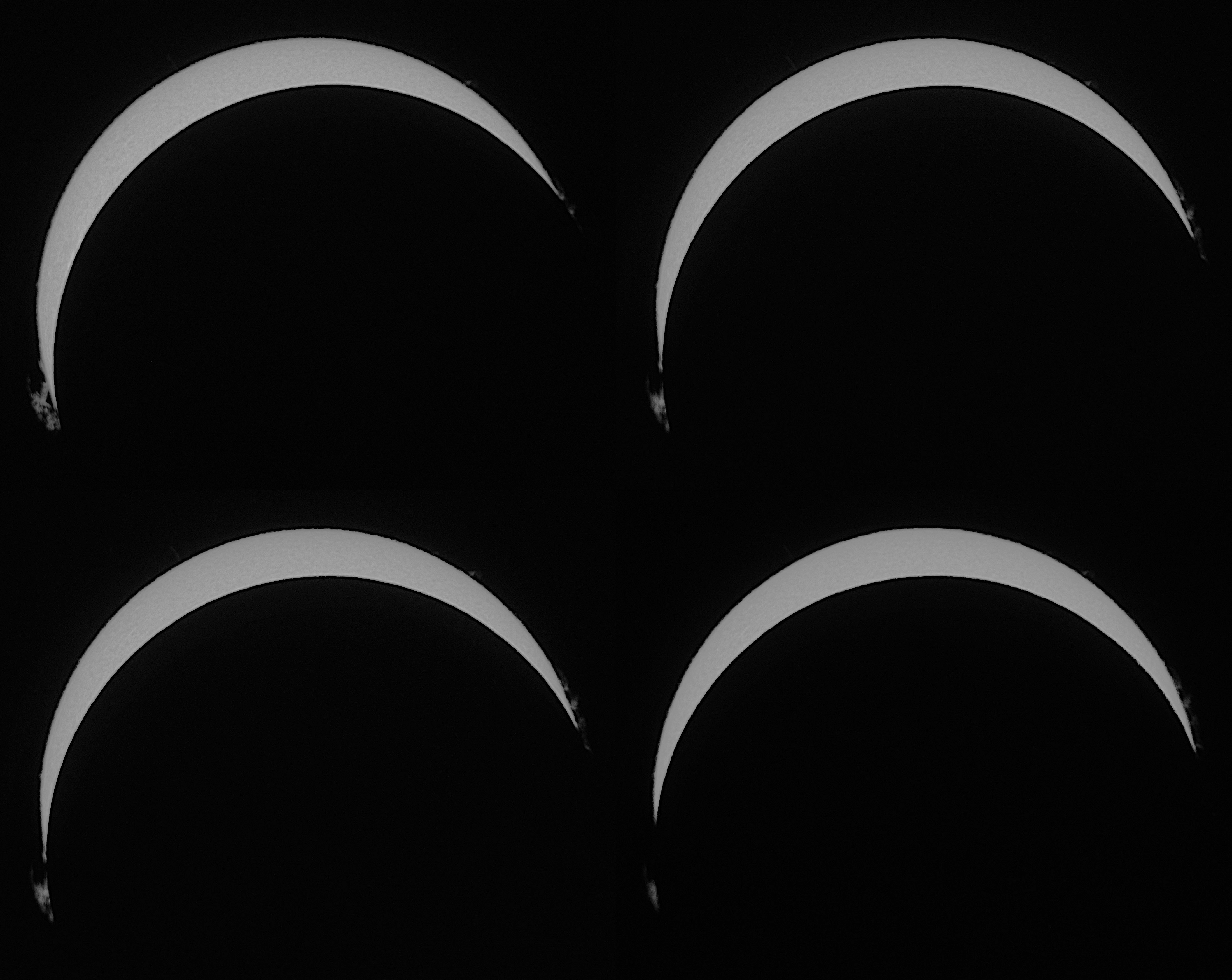
The following montage, captured around the time of 3rd contact, as the Moon just began to emerge from the solar disk, shows a limb prominence gradually being obscured. Each panel of the montage was created from 20 frames stacked and then processed in Registax and Photoshop. The frames are spaced nominally by 30 s in time, with the first at 18:12 UT.
Report by Neil Morley
I arrived at the Sutton Heath observing site with Roy Gooding and Lynne around 16:15 UT. Martin Cook was already unloading and setting up his equipment. Soon after unpacking my equipment, I discovered the Skywatcher SynSCAN mount I'd brought was missing its handset controller! This prevented use of OASI's 80 mm Widesky refractor for white light solar observing, but allowed me instead to circulate and meet members and enjoy a great shared experience. It was great to meet some members for the first time.
 Members of OASI enjoying the eclipse!
Around the time of maximum eclipse, approximately 18:13 UT, the sky noticeably darkened and shadows on the ground became more clearly defined. The temperature fell, birds started singing, and some, notably a flock of seagulls, flew directly overhead towards their roosting location on the coast. It was strange because the Sun's elevation was still ~10° above the horizon. What an experience!
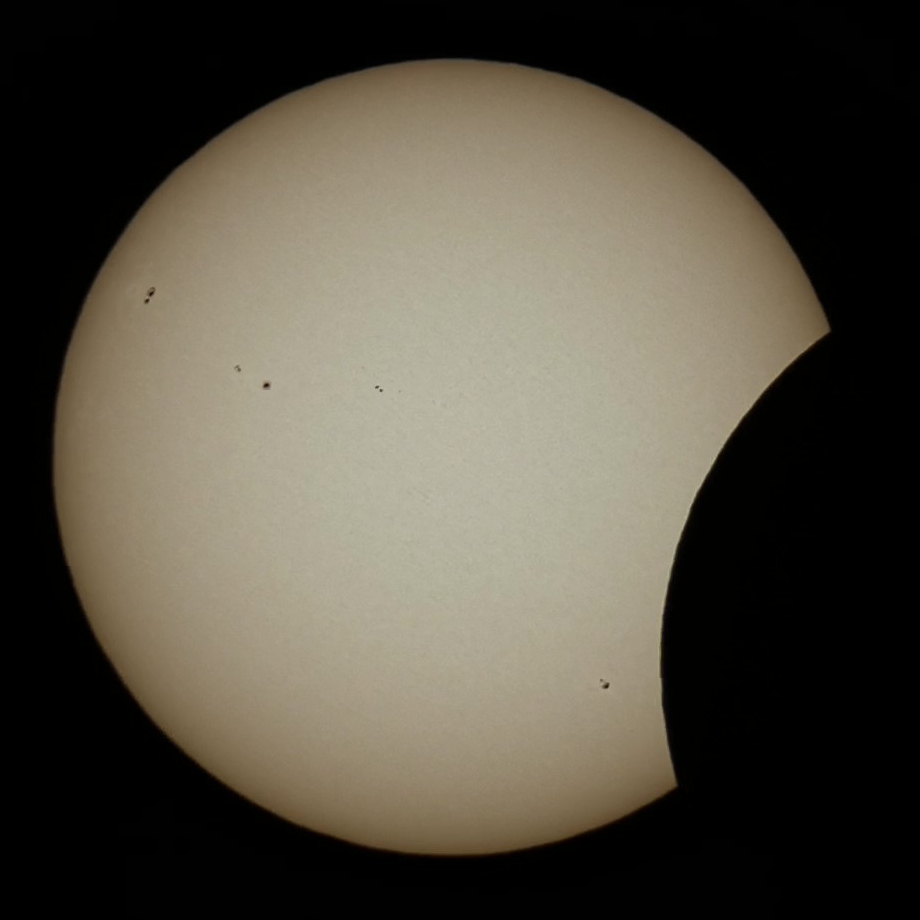
Solar images below were taken using a Motorola G31 smartphone held to the zoom eyepiece in Roy's Skywatcher ST102 refractor. A Lunt 1.25” Herschel wedge with variable polarising filter generated an eye-safe white-light solar image. I've applied minimal post processing by cropping the images. As maximum eclipse approached, the amount of visible glare increased in the photos; this was absent when using the eyepiece visually.

Thanks are due to Andy Gibbs and Martin for choosing the observing site and to all members who attended and made the event truly memorable.
Andy Gibbs used a Seestar S50, with Baader white light filter, to create a timelapse video of the eclipse, taking an image every 20 seconds. The video was edited in PIPP to improve stability of the image. The end of the eclipse was hidden by trees on the horizon.
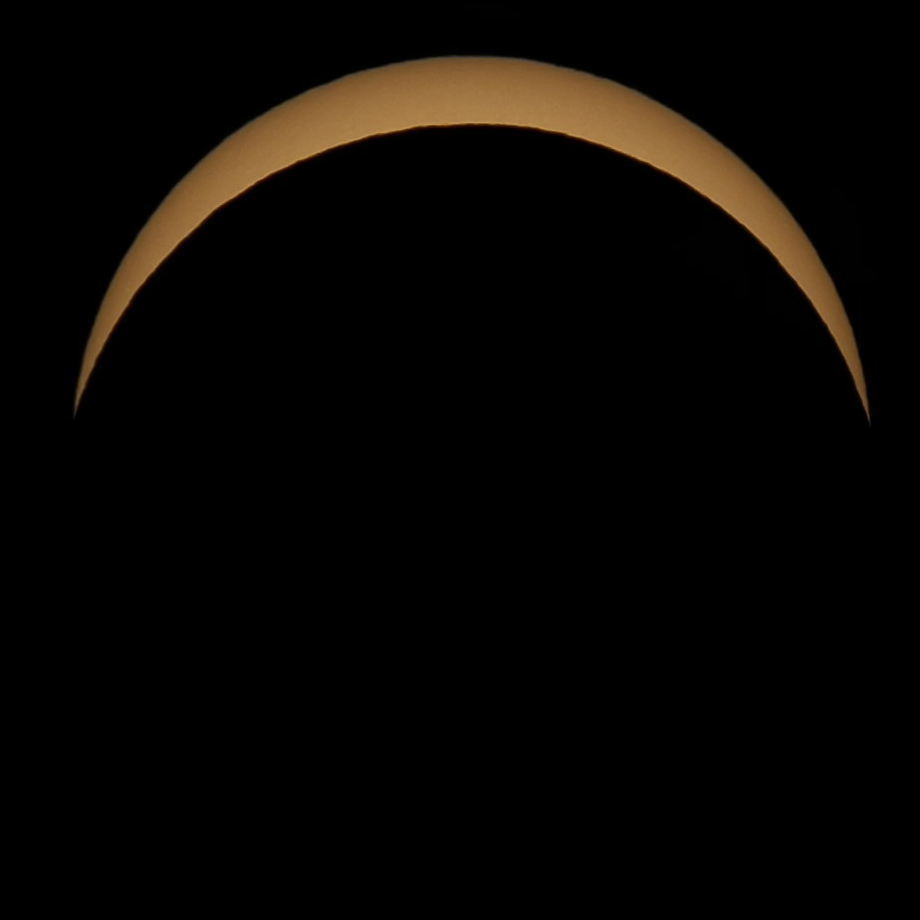
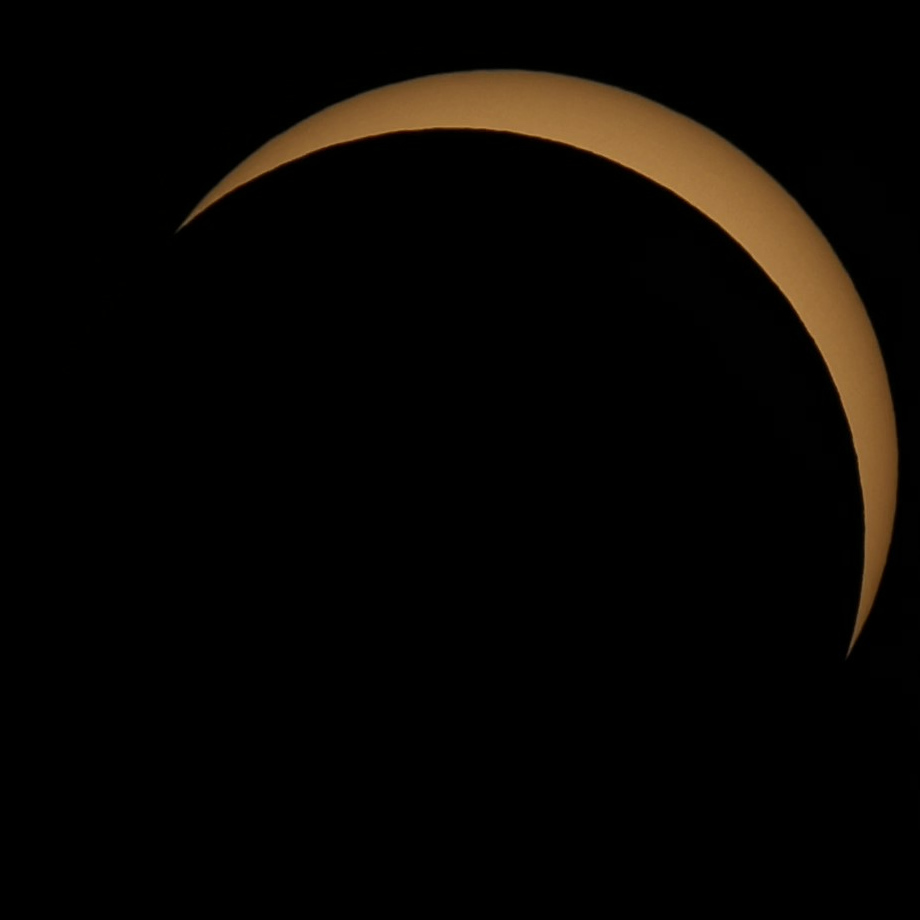
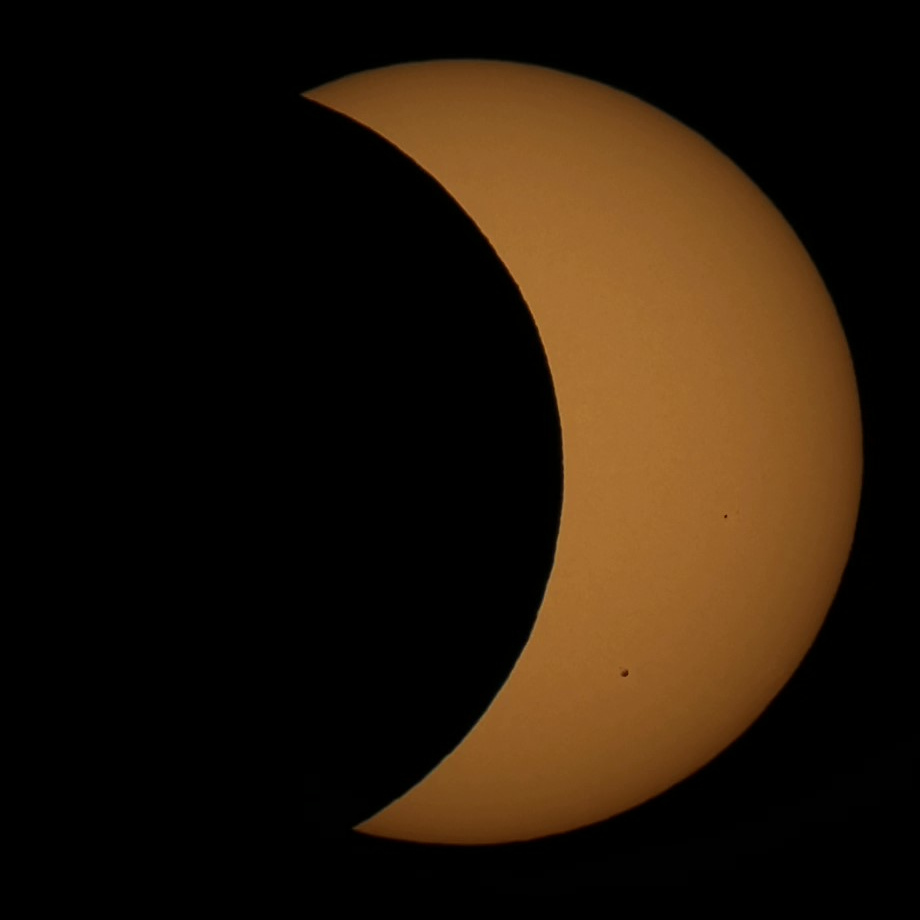
Matthew Leeks used a Lunt 60 mm Hα telescope, which revealed a large filament and, nearby on the limb, a large prominence.

Nick Tipping obtained images by photographing through a pair of eclipse glasses with an iPhone.
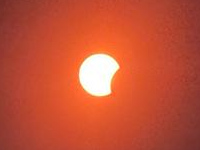
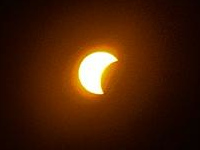
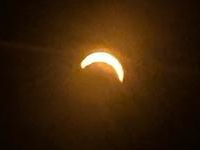
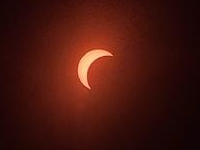
Stephen Olley used a Skywatcher Evostar 72 on an altaz mount with Nokon D3400 SLR and a homemade solar filter.
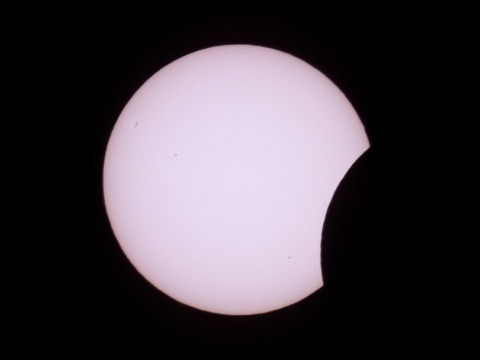

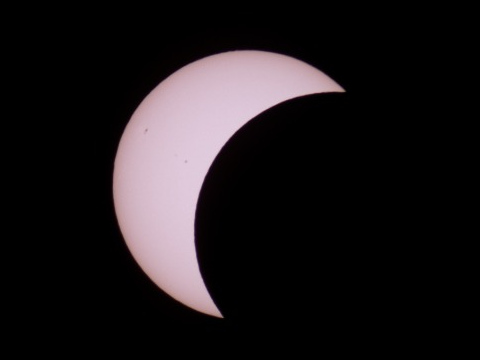
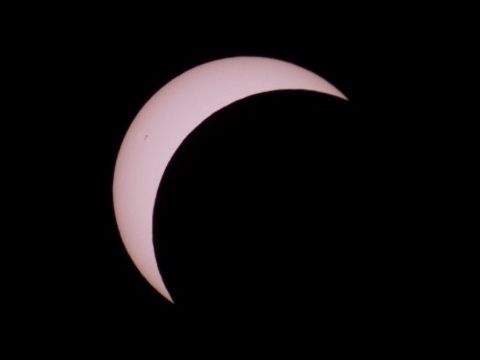
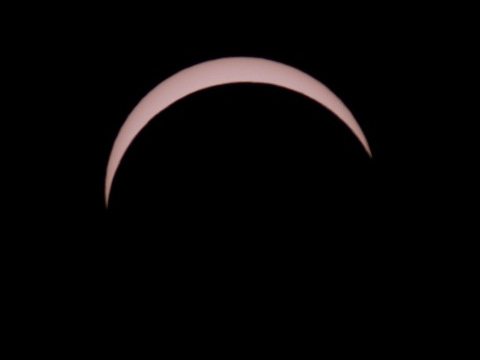


Video by Gabbi Crane.
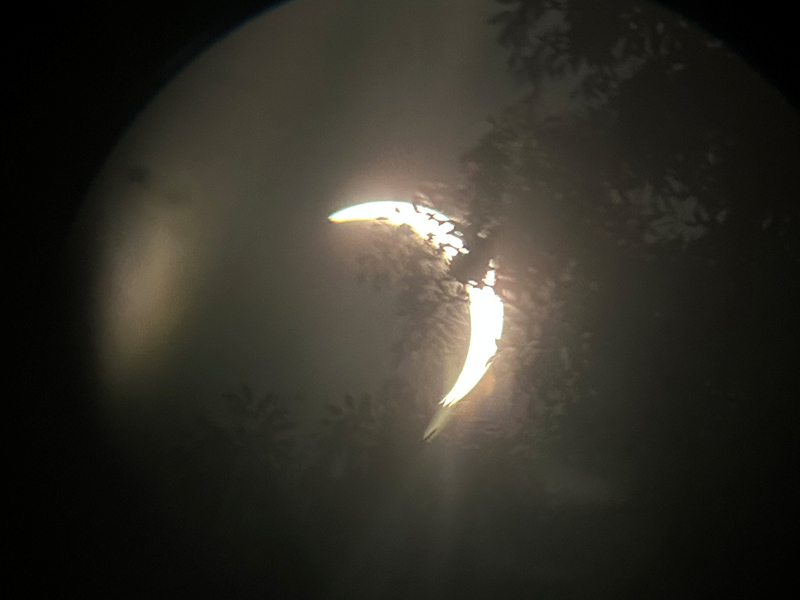
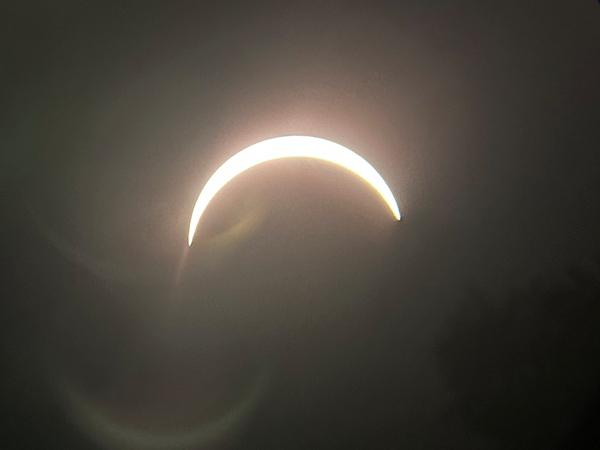
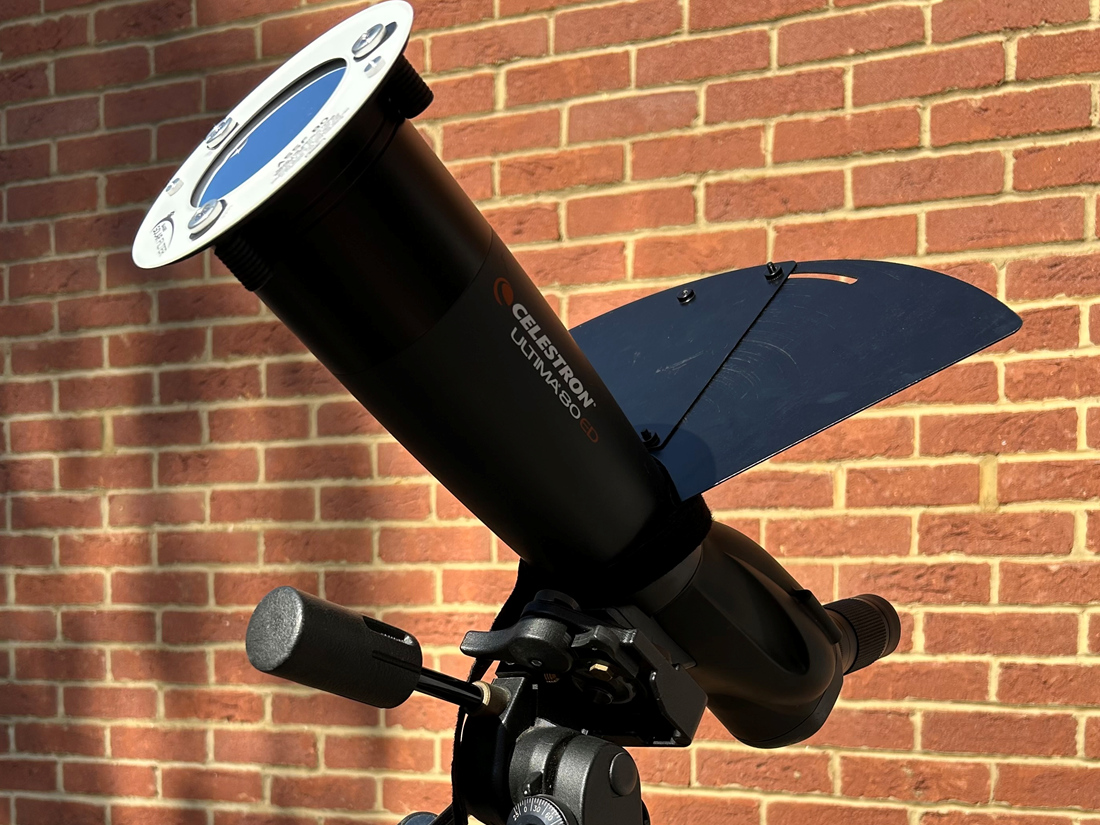
Bill Barton, FRAS observed from East Ipswich using a Celestron Ultima 80 80 mm spotting scope.
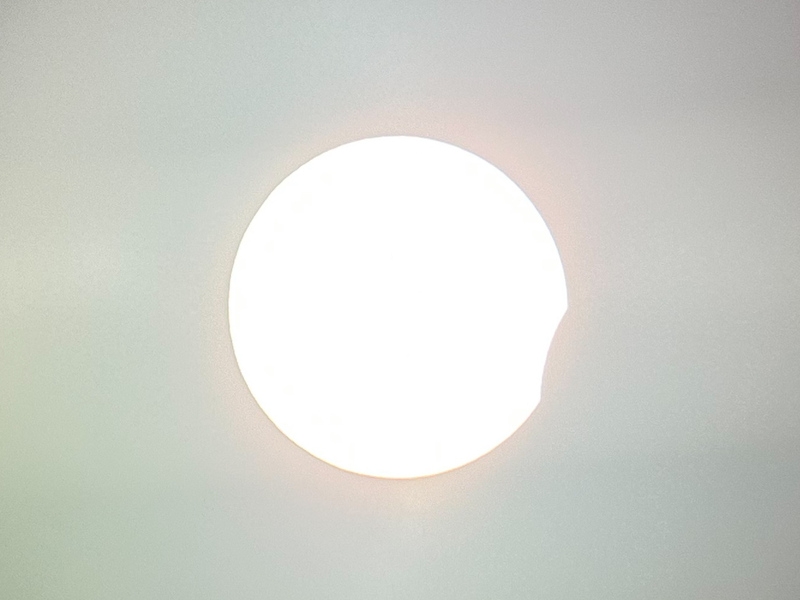

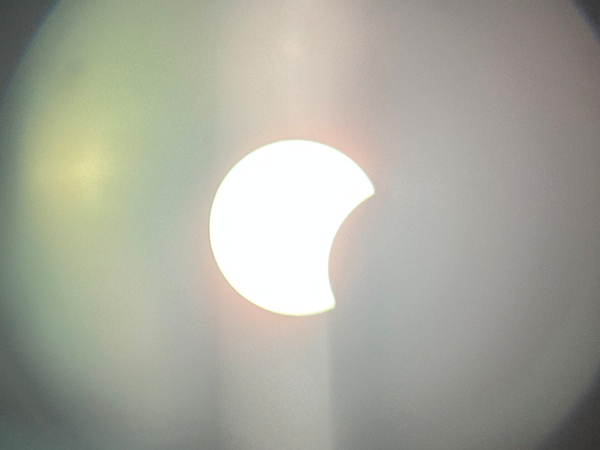
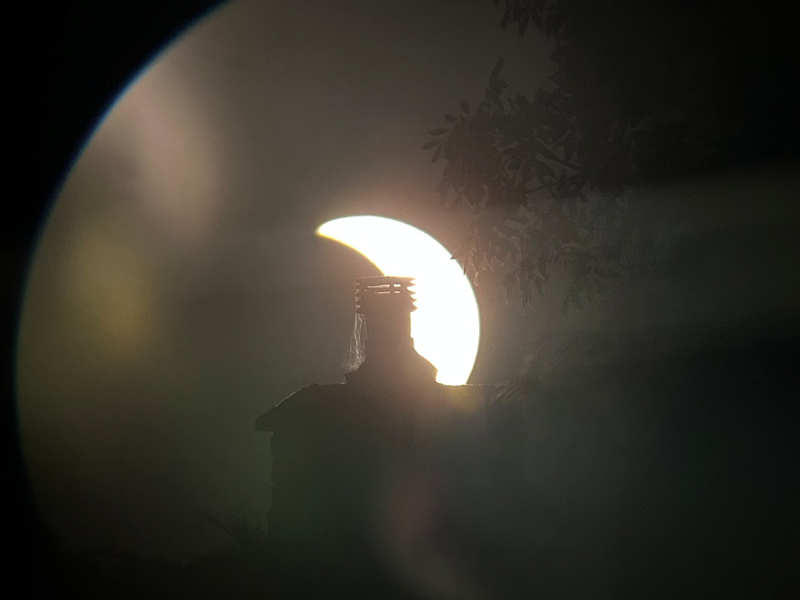
Success is fun- failure is funnier!!
Plan A
See totality in Cuenca, midway between Madrid and Valencia, where my Spanish tutor lives. Totality would last about 50 seconds. However, there was a heat dome over Europe and forest fires raging in Spain. Temperatures would be in the high 30s. "We" decided not to go.
Plan B
See the partial phases from home. Actually, the next door neighbours had a clearer horizon and, as they were away on a cruise that included seeing the eclipse, they allowed me to observe from their house. I set up on their upstairs landing.
Tripods were useless, so I mounted two cameras on large wooden boards, one with a straightforward three axis head for a static 80 mm lens that would allow the Sun to drift diagonally through the FoV, the other an Ioptron Skyguider Pro and head with a 500 mm lens that would track the Sun.
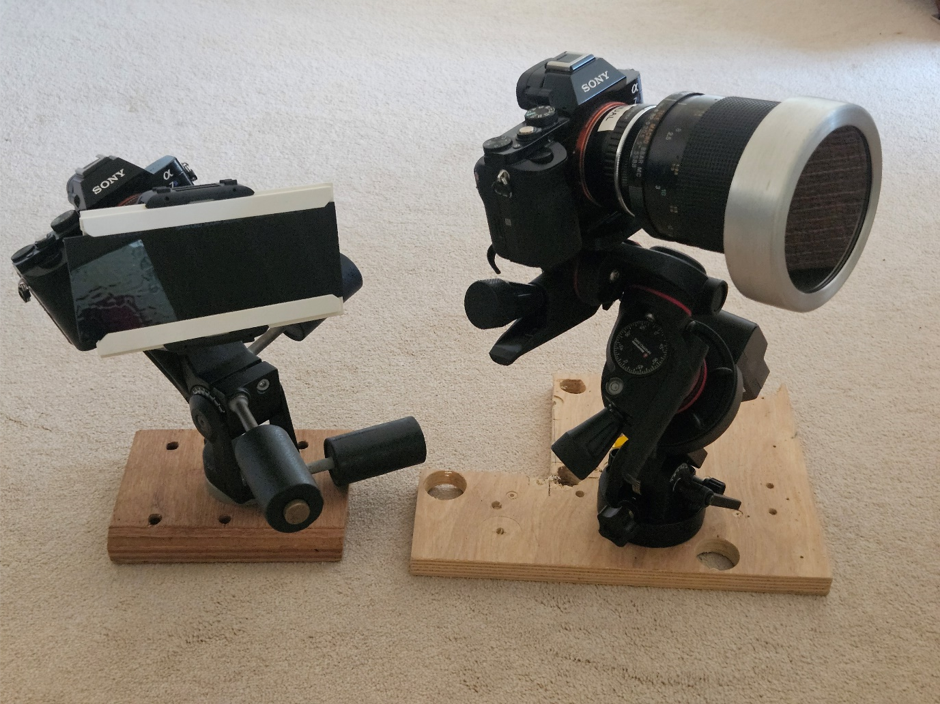
Both cameras were Sony A7S Mk1 models, controlled by laptops to allow adjustments to exposure to be made without touching them. This approach was new to me. The camera screens were at an awkward angle to see anything in the (hopefully) bright daylight. The laptops were indoors, with their screens in the shade.
I suffered numerous issues with communications due to laptops and cameras not recognising one other: the cameras were not compatible with all laptops. This resulted in many trips back and forth to base to fetch various item, including a Sony A7S Mk3 and an old blue laptop.
The Mk3 camera produced overexposed views of the Sun, so much so that I returned home to fetch a different solar filter. Alas, when I returned a minute later, disaster struck: I had locked myself out of the house 10 minutes before the eclipse started!
Total panic set in! What to do? Who to call? All the laptops were running, the driven mount was running, but I could neither start imaging, nor switch anything off. The driven mount would eventually collide with itself, potentially damaging something. Where were the keys? Had I dropped them in my house? No. I thought that I must have put them on the window ledge. The upstairs windows were open! I only needed a ladder to get them!
I asked a neighbour for help with the ladder. I climbed up to look at the window ledges, but could see nothing. The next option was to climb into the house via the open window, moving the cameras out of the way. Alas, the windows do not open a great deal, making the manoeuvre difficult (for fat people like me!) Stretching as far through the open window as possible, I could see the keys, on the floor out of reach. Fortunately, my neighbour also possessed a litter-picker which he fetched. I was able to use it to reach the keys and I was then quickly able to enter via the front door. Hurray!
By this time, the eclipse was close to maximum phase and I abandoned any hope of taking pictures. I packed everything up, occasionally looking at the partial phase in a brilliantly clear sky.
Post Mortem
So what went wrong (up to the point where I locked myself out!)
Cameras:
Laptops:
Leads:
Review of Plan B
Plan B originally used the two A7 Mark Is with the Win11 and white Win10 laptops. I recall having both working at the same time, but now I wonder. On the day, the Win11 laptop connected with a camera, but there were problems with the Win10 laptop and the other camera. Swapping leads didn’t improve things. I went home to retrieve the blue laptop and the Mk3 camera. I ended up with the Mk3 mounted but the image was so overexposed that I returned home to fetch a different solar filter. That is when I locked myself out!
So where did things go wrong?
A comms issue
But there is also a comms issue. So, what can talk to what? For remote control of a Sony camera there is Sony specific software IEDT (Remote).
Google informs me there could be issues with cloud-based services, like Google Drive, Lightroom, Dropbox etc., interfering with the operation of the USB ports. (Don’t ask me how!)
Off to Task Manager to search for applications that start automatically and look cloud based. I found none of the above, but there was one called Apple Push, a cloud service for iOS devices (on a PC!) I culled it, and also a couple of applications that don’t need to start on boot.
I rebooted, then success! I can now remotely control the Mk1 cameras with the white Win10 laptop. But I'm just not sure when that will ever be needed again!
And my neighbours? They were aboard Cunard’s Queen Victoria, stationed off Tarragona, and enjoyed a fantastic view of the eclipse!
Mike Whybray observed from Nacton sports field, where he used a colander as a multiple pinhold camera!


Having missed the UK eclipse of August 1999 (and various others that I might have considered seeing in the US, Faroe Islands and Australia) the eclipse of August 2026 seemed too good an opportunity to miss. The odds of good weather somewhere in Spain in August were pretty good, and I’ve been to Spain several times before. You’re almost spoilt for choice, although the compromise is that the further north you are, the less certain you are of good weather, but you experience a longer eclipse!
Add to the mix the prospect of wildfires, and the trip took on a more serious tone. The government’s advice was not to just stop and observe the eclipse in some random field or layby in case a nearby wildfire forced road closures. So, during the last few weeks before we travelled, I asked ChatGPT to monitor the weather and wildfires in Spain and recommend a suitable viewing location. However, I didn’t want to blindly trust it, as AI can hallucinate very convincingly. It selected a place that could accommodate 600 people, which may or may not have been adequate. In the end, we chose another location, in Navalafuente, about 70 km north of Madrid. Our choice turne out to be a good one, as our hire car (which we thought would be a Renault Clio or similar) was actually a VW Campervan…and electric! So, its range was somewhat limited! On the 87% charge that we had, it wouldn’t have made it to either the northern or southern coasts. And although it gave a smooth ride, it was not exactly the most practical vehicle for the narrow backstreets of Madrid, where our hotel was located. And the underground car park was not going to be easy to navigate.
There was an official poster for the eclipse in Navalafuente, but the venue was just given as El Tomilliar football pitch– which literally translates as "Thyme Field", a common place name in Spain. Nowhere could I find a more official name. We did ask at a local café if anyone knew about the event, but unfortunately their English was as good as my Spanish (I could order a coffee and beer, but not much else). According to Google Maps there was a football pitch called Campo de Futbol Hector Sanchez – but no El Tomilliar. There was a sports centre in the town, with a field next to it, but it looked overgrown and also didn’t command much of a view of the horizon, which we’d need since the eclipse happened close to sunset.
So we made our way to the Hector Sanchez sports field, and found a few other people waiting there too. None of them knew if this was the right place, but my wearing a Nasa cap must have made me seem like I might have more information. If the locals didn’t know where the venue was, what chance did I have? But, for several people to have made the same mistake began to convince me that maybe this was the right place after all…
And so it was. The event was free and volunteers were handing out bottles of water and eclipse glasses. A DJ was also there, playing upbeat EDM music. I don’t know how many people turned up, but it must have been a few hundred at least. The pitch was astroturf, so the risk of fire was reduced. From our position though there was a mountain range on the horizon, and I was a little doubtful that we would actually see the eclipse. I reasoned that the organisers would have checked this.
I set up my camera on a tripod, with the intention of taking photos only during totality (having not brought a solar filter). I also set up a second camera on timelapse to capture the change in light levels (but I’ve yet to process that – the exposure automatically adjusts and I want to make the timelapse look more like it did in reality). Many people told me beforehand that I should make sure everything is set up BEFORE second contact, to enable viewing the experience first hand;…after all, there are bound to be thousands of photos, many probably better than I could take.
The atmosphere on the pitch was good: everyone seemed to be having a good time, enjoying the novelty of it all even if it was scorching hot. First contact was barely noticeable, even through eclipse glasses. All the camera equipment was set up (with a second pair of eclipse glasses held over the lens by some insulation tape), so I just had to click the shutter once in a while.
As second contact drew near, I felt there was a palpable sense of anticipation. The crowd that had been quite merry and jolly became more subdued. I don’t know how many have ever seen an eclipse before, but I guess most hadn’t. I was becoming a bit nervous too, though I’m not sure why. I think I was worried about missing a good shot of the eclipse…which was precisely what everyone said NOT to worry about. But worry I still did. I can understand why those in the UK may have felt disappointed by the partial eclipse. Even at 90% coverage, the Sun is still very bright, too bright to look at…though the sky had darkened.
It wasn’t until the last couple of minutes that the sky became nearly black, almost as dark as night. At this point the DJ put on ambient tunes, and the whole atmosphere changed. I didn’t really believe totality was going to happen but, as the air grew cooler and the light faded, we saw the very last sliver of the Sun shrink to a tiny but brilliant "Bailey's bead" before finally become totally covered. A cheer went up from the crowd and then we could at last see the corona, which looked pale, almost like a cloud. I think it must be a similar effect to viewing an aurora. Camera images pick up the colour more strongly than the human eye. But… I forgot my distance glasses! I am a little short-sighted and, having been in bright sunlight all afternoon, I hadn’t considered that when totality arrived it would be too dark for the distance glasses and my normal glasses weren’t to hand. So, I didn’t quite see by eye the subtle details, though my camera captured them. I didn’t waste time trying to locate them, and just tried to appreciate the view. Naomi took a few videos, and captured second contact well. I noticed Jupiter high up to the south and a few bright stars too.
Totality lasted only about 90 seconds, then the Sun suddenly appeared again. I think third contact is not given the respect it deserves… The eyes are dilated, and the brief moment of brilliance could actually be quite damaging to them. Eclipse timers/alarms are available to warn of the end of totality. Fortunately, a trip to my opticians a few days later put my mind at rest.
I’m very glad we made the effort. The eclipse was certainly a sight to see, and one that I recommend everyone to see at least once!
Below, still images of the eclipse were taken with a Canon 7D and 300 mm lens at F/5, ISO 400, 1/25 s exposure.
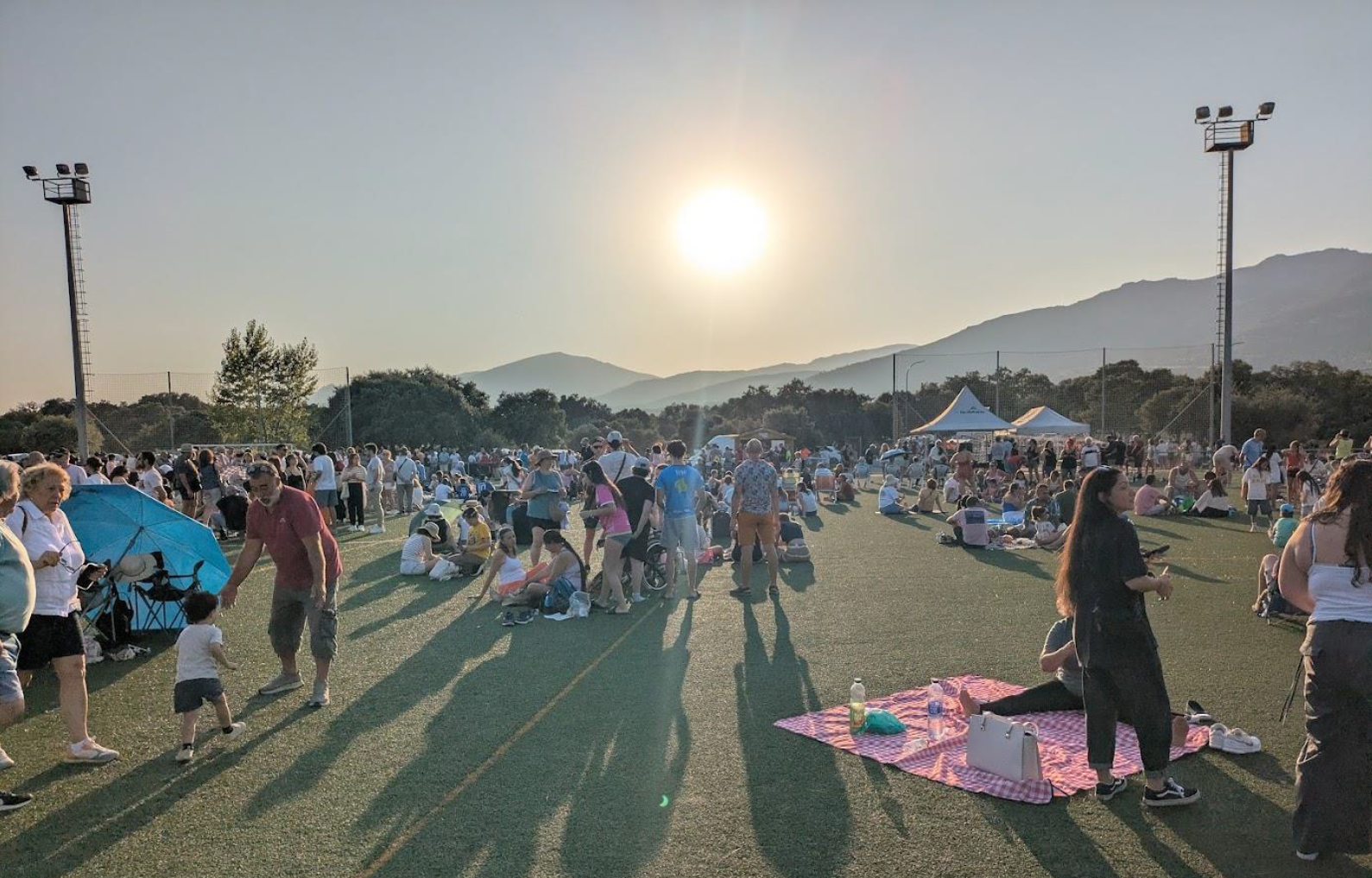 The crowd at the Hector Sanchez sports field.
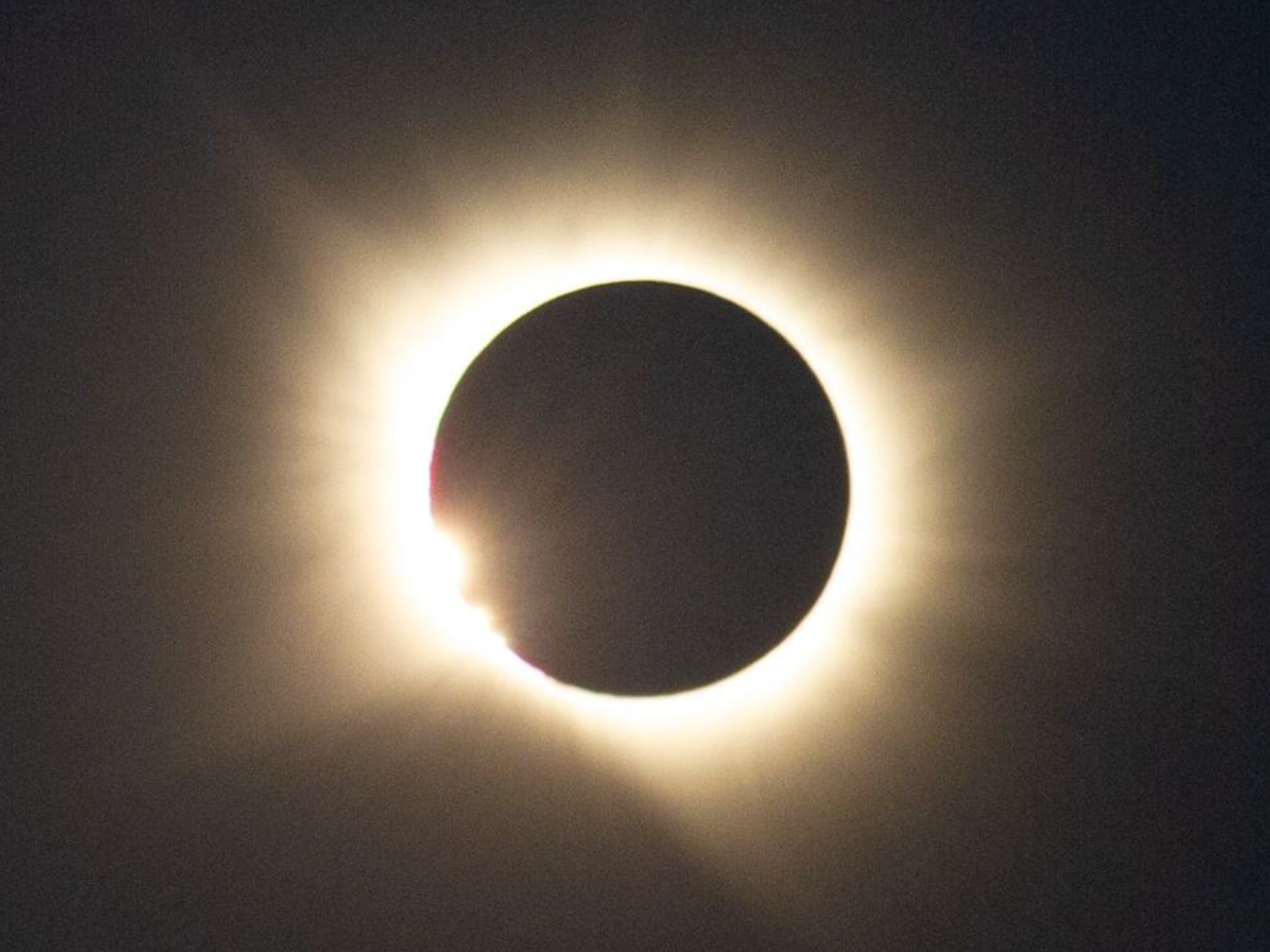 A moment before 2nd contact.
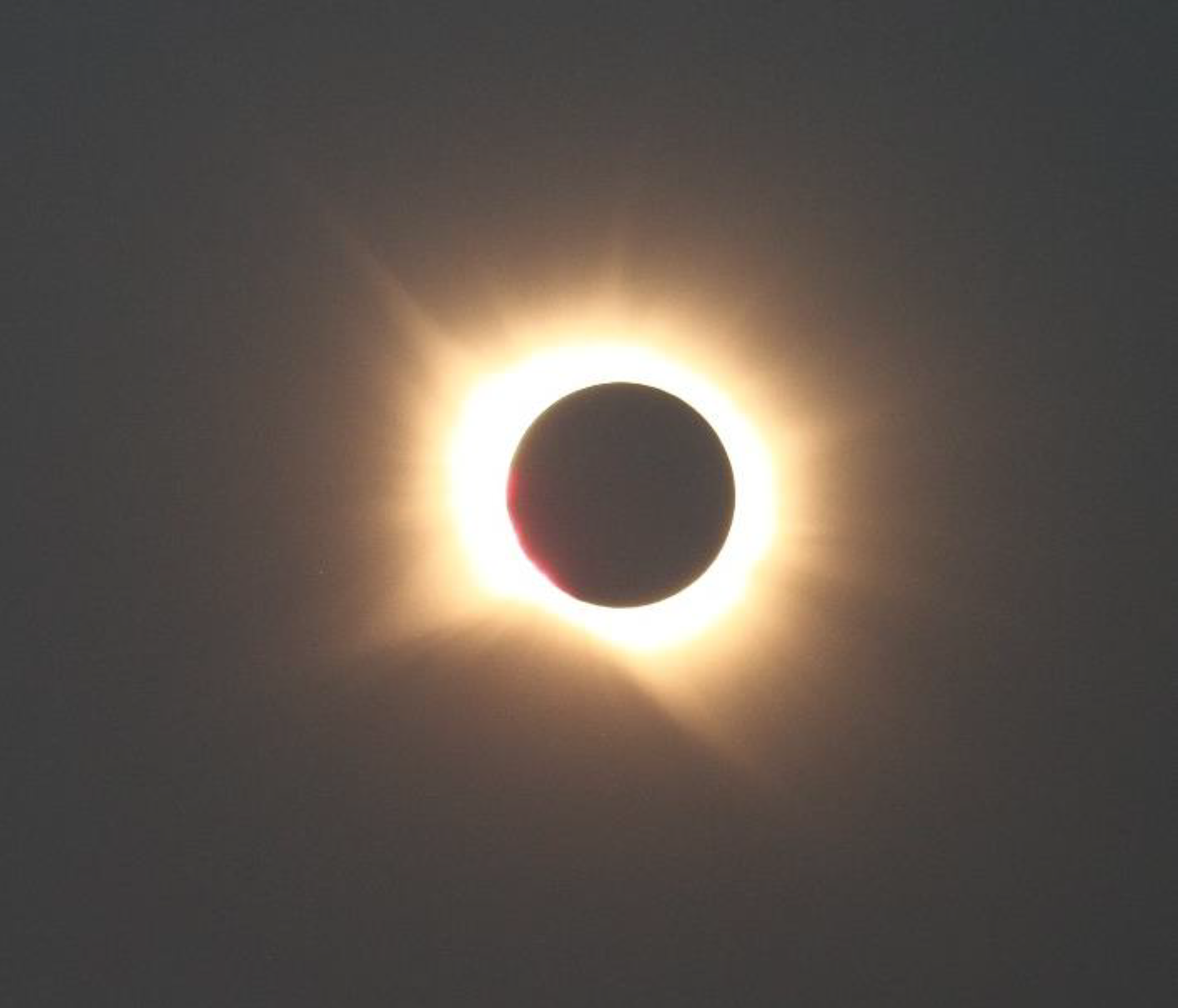 Totality.
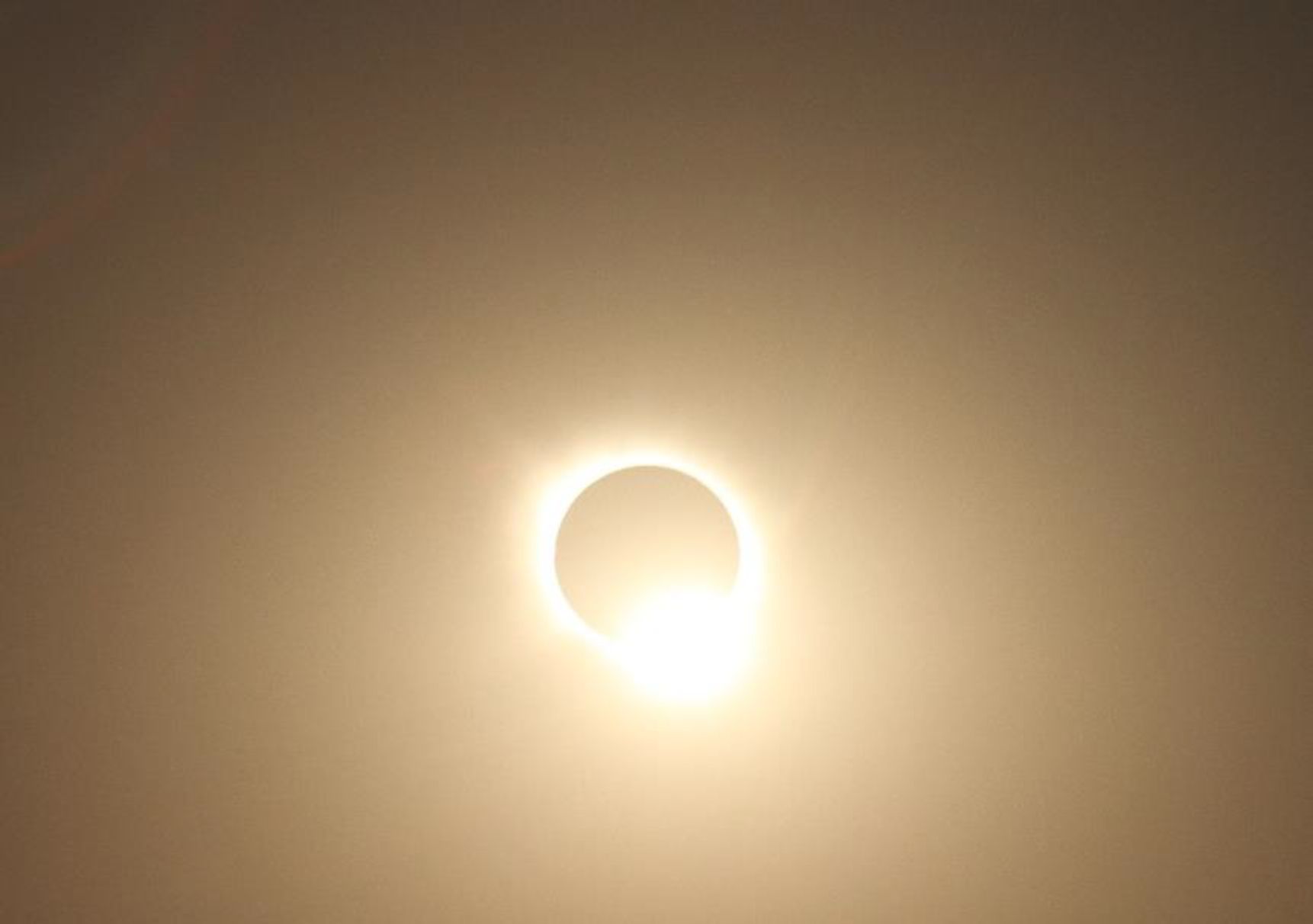 3rd contact.
The trip to observe the eclipse started badly and became progressively worse! At least for the first two days travelling to Barcelona. It started with a cancelled train from Felixstowe, trespassers on the line at Ilford, and a Heathrow Hotel transport running 40 minutes behind its timetable. All of which made for an eight-hour journey that should have taken five at most.
The following day, the flight to Spain was fraught. BA had lovingly bounced me from the flight having oversold the seats. It was only 25 minutes prior to take off when I was finally allocated a seat. OK, it had extra legroom, but the delay in allocation was a hassle I could do without!
On arrival at Barcelona the luggage was lost. ALL the luggage! The airport displayed carousel 13 but the luggage came in on carousel 14!
Then, in the terminal, there was no sign of the tour company rep. Luckily, I met a couple I recognised from previous eclipses. They managed to spot the taxi driver holding up a small piece of paper bearing our names.
Barcelona. A fine city, or at least it will be when they finish building it. The famous basilica, the Sagrada Familia started construction in 1882 and is due to finish in 2036. If you believe that… The hotel we stayed in was totally themed around space travel. Odd, given that it was part of the main Barcelona railway station. Perhaps a railway travel theme might have been more appropriate. However, each room had space travel themed images enclosed in hemispherical plastic domes. In the vast hotel reception, a whole wall had a giant display looping a very good video explaining what was meant by a light year and giving examples of various objects and galaxies, incidentally most of which I have imaged with the SeeStar!! The video also mentioned black holes and Seyfert galaxies, so any traveller waiting in reception could learn a lot! For some reason the hotel offered free glasses of Cava for the whole of the second day. It was inclear whether this was an everyday occurrence or just a one-off. Either way, I managed to sample four glasses.
Then a train ride to Valencia. This passed mostly without incident, spacious legroom carriages and, above all, working air conditioning. As with most trains it ran about 30 minutes late, which had the knock-on effect of the police moving our waiting coaches away from the station entrance. This meant we had to haul our cases in convoy for about 700 m along fairly rough ground in 35°C heat. At least the hotel was quite nice. The beer was cheaper and better (local) than the Heineken served in Barcelona.
It was here that a group of five widowed grandmothers from Florida and Texas seemed to want to adopt me! I spent most of my time trying to avoid them. One by one they came to sit next to me in the bar and in the restaurant, to introduce themselves.
Then disaster struck. What is the worst thing that could happen? Well in my case, it was loss of access to email. My laptop charger blew up, creating an indoor fireworks display whilst charging. Not good when emanating from the mains lead.
The day got better when I discovered an all-you-can-eat Japanese buffet restaurant. Basically, eat as much sushi as you can for €28, the only limitation being that you could only order five things every seven minutes. The limitation included drinks, pickled ginger and wasabi: a novice mistake.
Next day we were off to Cordoba – a five-hour coach ride. On arrival the temperature had climbed from 30°C to 41°C, at 4.30 in the afternoon.
Onward to Seville and 45°C. From here we had coach tours to Jerez and Cadiz. In Jerez, the home of sherry, there was a visit to the Gonzalez-Byass bodega. They make, amongst other things, Tio Pepe and Croft Original, the latter purely for the UK market. Here they served a Sherry Spritz – mixed with elderflower and lime fizz and sprigs of mint. Delicious! Cadiz, the home of the Spanish Fleet, was once an island, but over the centuries it has silted up to become a peninsula. It retains its encompassing walls as an island citadel. It was here that I tried sea snails. They turned out to be whelks and went down well with the local beer.
Next, to Madrid, where we stayed near the Bernabéu Stadium – I believe it has an association with football. Madrid was expensive compared to the other cities, but the hotel did serve Pisco Sour cocktails, previously only seen in Chile. The food throughout the trip was generally good – lots of tapas. I have fallen in love with prawn and ham croquettes and the massive Spanish olives. Despite the wonderful Pisco Sours in Madrid, the eclipse cocktail of choice was Aperol Spritz.
Finally, we arrived in Siguenza, staying in the exclusive Siguenza Castle Hotel. This is a 12th century fortress that was virtually flattened during the Spanish civil war and rebuilt 80 years ago, this time with plumbing.
There were over 600 guests at Siguenza Castle: Astro Trails had booked the entire hotel. Four groups stayed there and three more coach loads came in just for eclipse day. There was security trying to keep the locals away from their prime viewing spot! Apparently, police were even called at one point. The viewing area was the car park, which sloped quite a bit. This would easily accommodate 600 people if the Sun were high in the sky but, with the eclipse happening at low altitude, everyone was worried about finding a pitch with an unobstructed view. The night before the eclipse, all you could hear were little groups muttering about plans B and C. My plan was to set up about 6pm. Coming out of breakfast on the morning of eclipse day, I looked out at the car park and saw that all the prime spots had already been taken. The earliest person to set up was in position at 04:30, some 15 hours before the eclipse. I was told that the next two groups set up at 07:30 and 08:30. It became pretty frenetic after that.
Most of the group of which I was a part were Americans and Canadians (mostly doctors of various sorts). There was a particular family with whom I had become pretty pally over the week. An elderly mother and father, thirty-something son and daughter and son’s wife (this was their honeymoon). The "kids" all worked for NASA in various interesting roles. The family was the third group to set up on the day, at 08:30, and occupied prime position #3. They had set up a large awning and had bought camping chairs in Valencia for this occasion. They invited me and half a dozen others to join them under the awning for the day. We took it in turns to "defend" the spot from interlopers. Everyone moaned about the awning blocking the view, so they had to write a note on the side, assuring everyone that it would be stowed well before first contact! The "kids" could not do enough for the "older" folk: they were continually popping down to the village to buy tins of coke etc., or queuing in the hotel bar for beer for us. So, I had shelter from the Sun and 40°C heat, continuous hydration, somewhere to sit, excellent company and a prime viewing site. I could not have asked for better!
The eclipse itself was one of the best I have seen. A large flare erupted on the left-hand limb of the Sun in exactly the same position as the first diamond ring and Bailey’s Beads.
 Siguenza Castle.
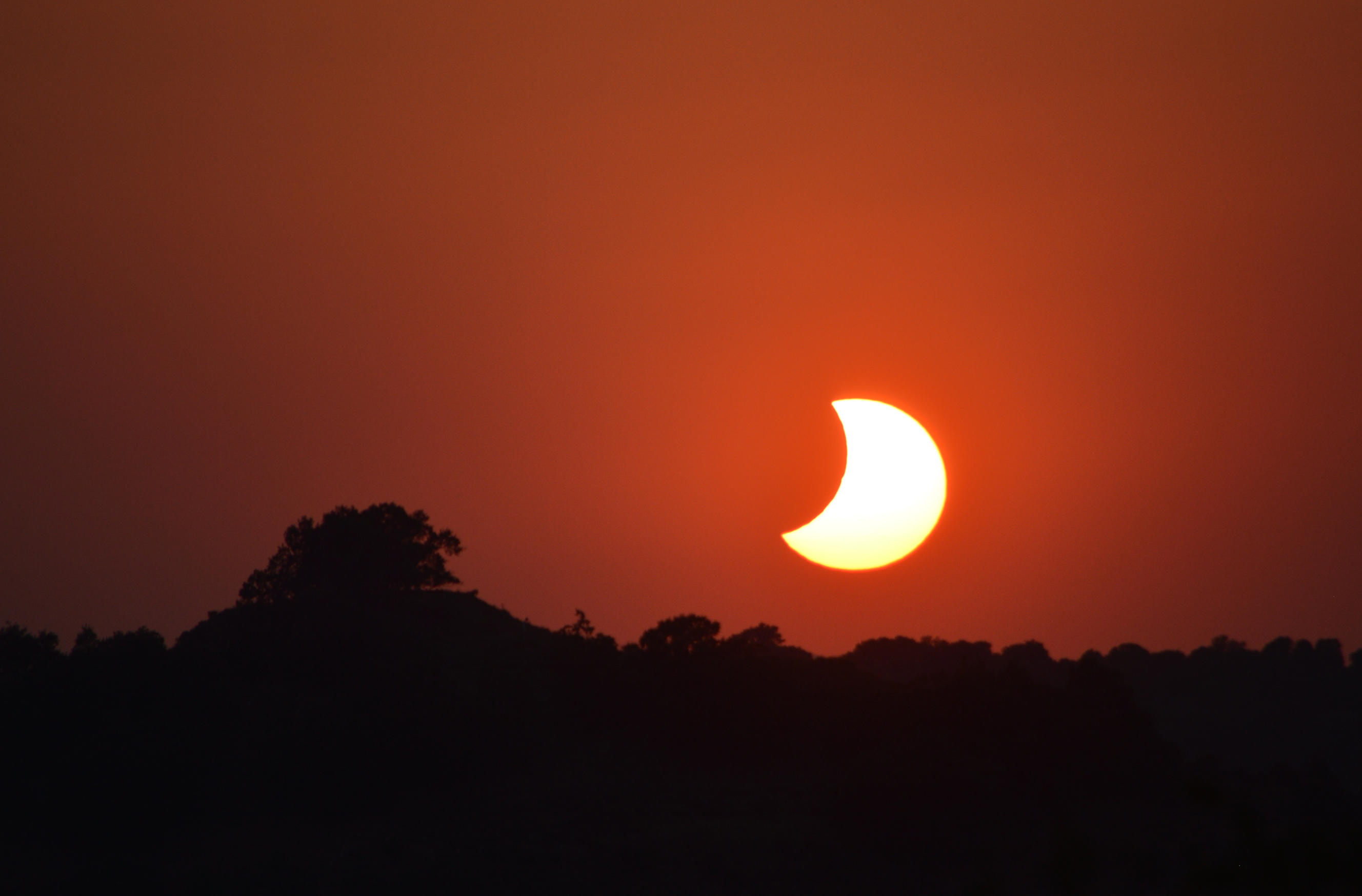 The Sun setting in eclipse.
I photographed totality with a Nikon D3200 and 300 mm telephoto lens at f/5.6. Exposure times and ISO ratings are as shown.
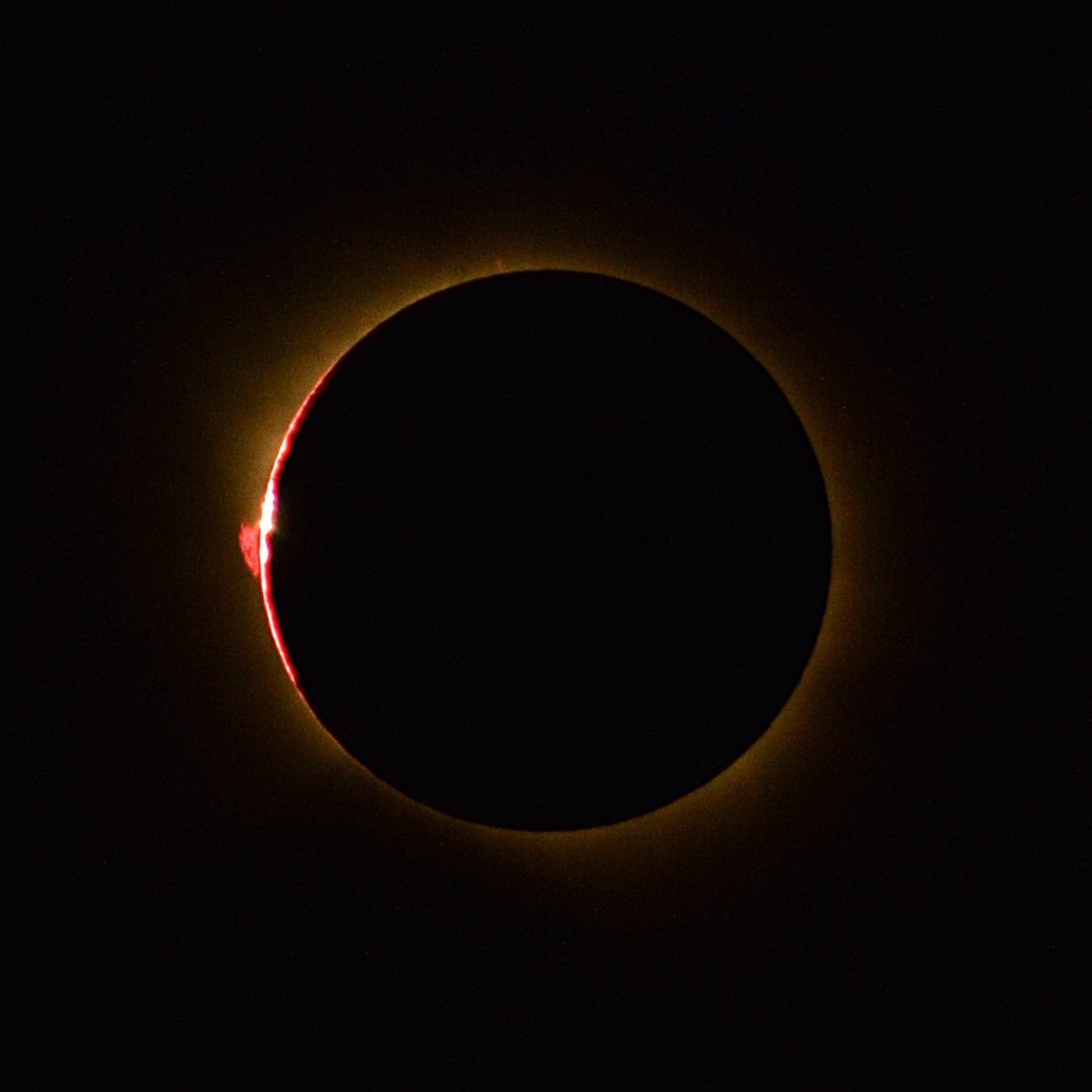 1/1600 second, ISO 400
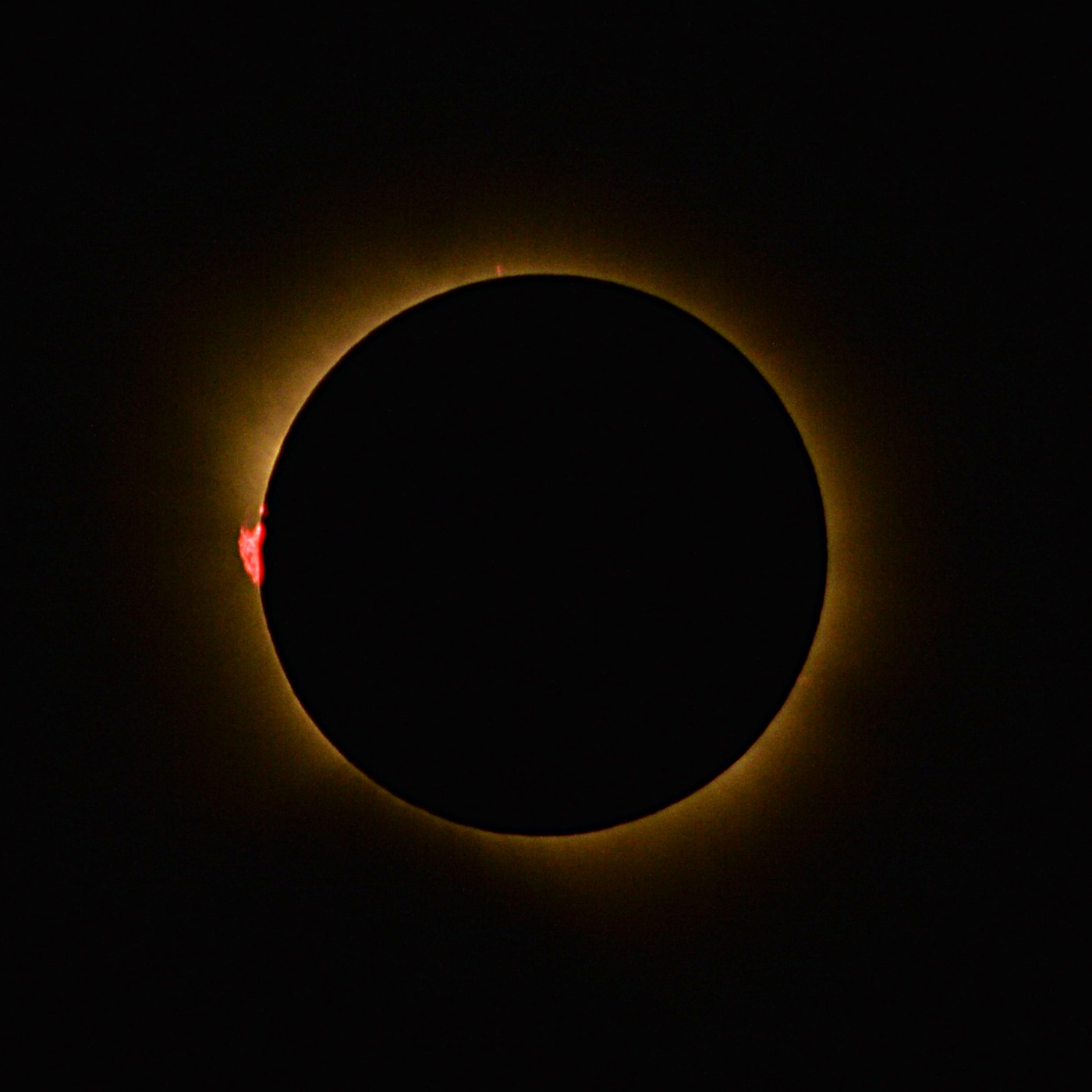 1/500 second, ISO 200
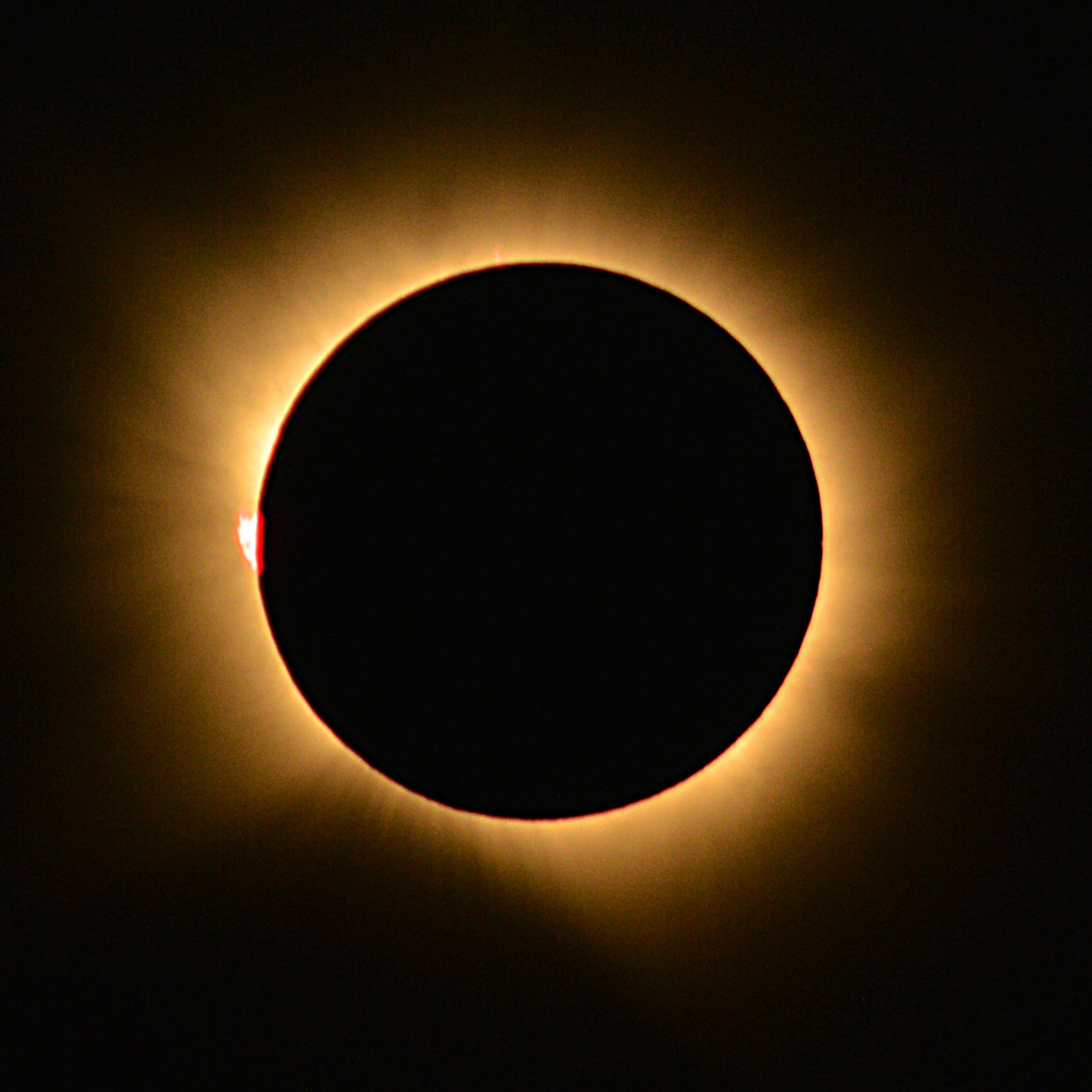 1/60 second, ISO 200
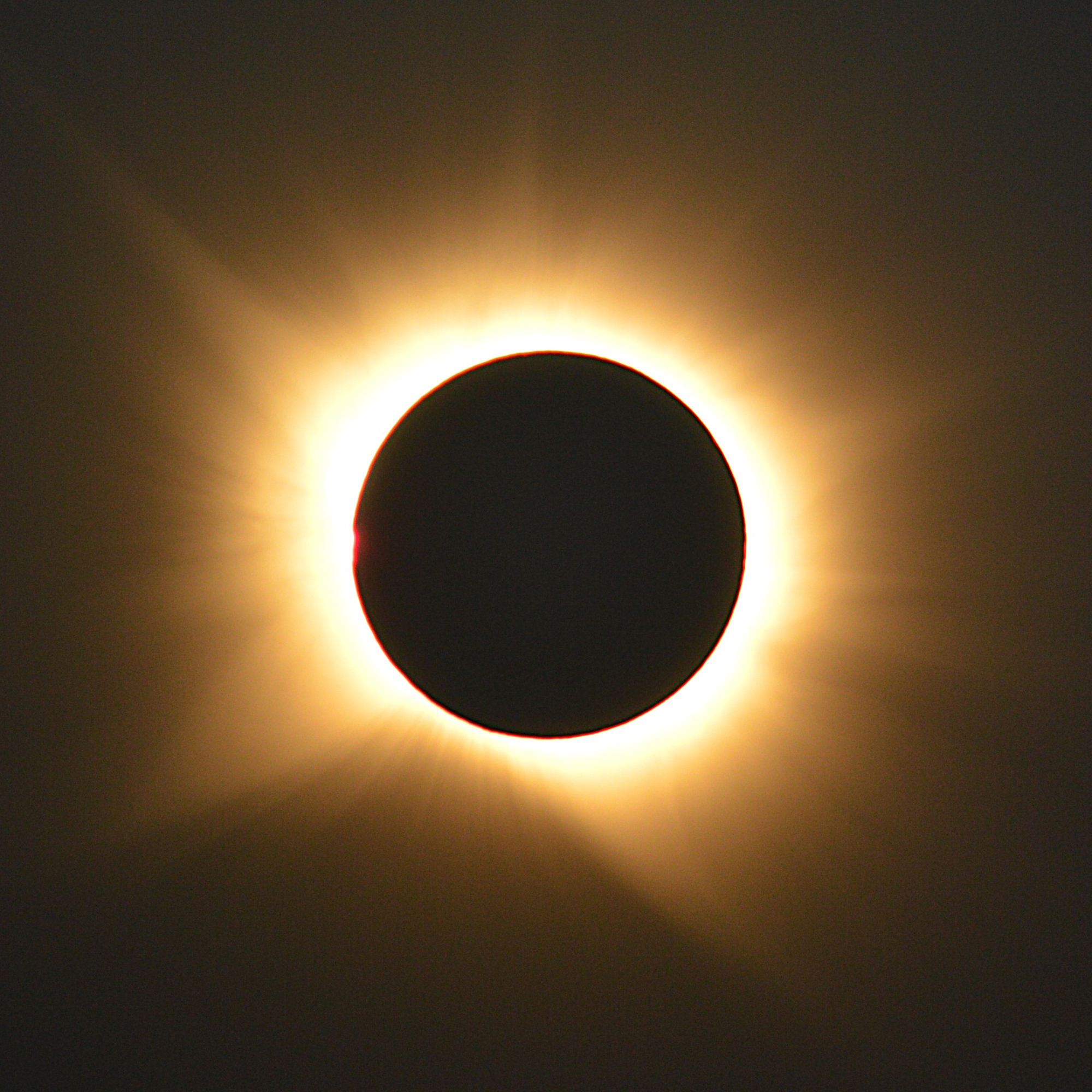 1/4 second, ISO 200
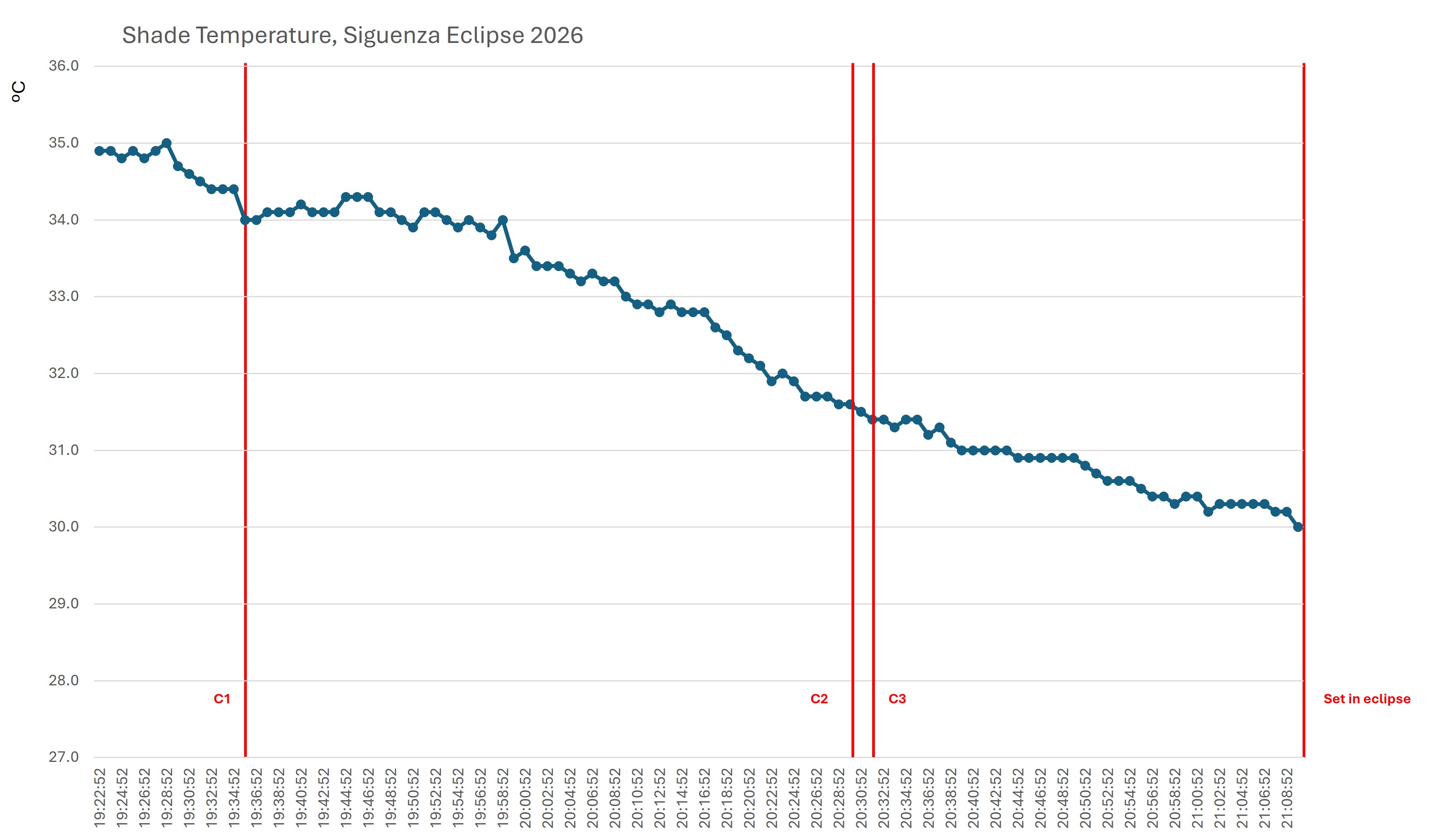
Besides photographing the eclipse, I recorded the temperature in the shade from before first contact to sunset (the Sun set in eclipse). As can be seen in the graph below, the temperature decline is very similar to the normal evening/sunset curve.
Alas, the sky over Prestwick was leaden and observations of the eclipse were not possible.
